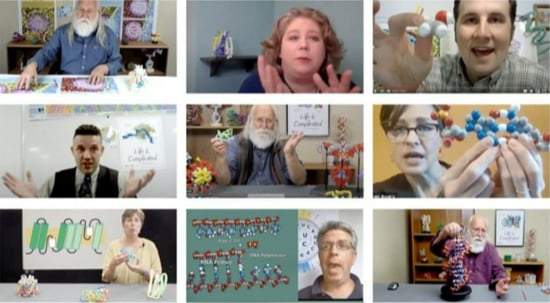
Explore the molecular world from a new perspective! Join 3D Molecular Designs at the 2026 NSTA Conference in Anaheim to see how modeling transforms student learning.
Friday, November 6
8:00am || Room 239
Session Title:Water You Wondering? One Model, 10 Phenomena Presenter:Chris Chou Session Description: Explore 10 questions with one set of 3D water molecules! In this hands-on session, investigate phenomena from water droplets and floating ice to chemical reactions, cells, and the water cycle. Discover how physical models can help middle school students make the invisible visible as they predict, explain, critique, and revise their thinking.
9:20am || Room 239 Session Title:Decoding DNA: Using Models to Wonder, Explore, & Explain Presenter:Chris Chou Session Description: What happens when we give students a model—but don't tell them what to do with it? Experience the WE² Model Framework—Wonder, Explore & Explain—as you play, notice, question, investigate, and make sense of DNA using physical molecular models. Then shift your lens from learner to educator to uncover the teaching moves that turn hands-on modeling into genuine sensemaking—and consider how to use WE² in your own classroom.
10:40am || Room 239 Session Title:Making Sense of Membranes: Modeling the Invisible Presenter:Chris Chou Session Description: Explore cell membranes through hands-on modeling! Investigate how molecular structure and interactions explain membrane formation, selective permeability, transport, osmosis, cell signaling, and homeostasis. Discover how physical models can help biology students make the invisible visible as they predict, explain, critique, and revise their thinking.
1:20pm || Room 239 Session Title:Molecules of Life Presenter:Tim Herman Session Description: Life happens in water—and therefore many teachers consider water to be the first molecule of life. But there are four other small molecules that make up the major constituents of a living cell. These other molecules include amino acids (which become proteins), phospholipids (which become membranes), carbohydrates (which become cell walls and food), and nucleotides (which become DNA and RNA). This workshop will explore physical models of these molecules of life and how they can be used to introduce your students to the molecular basis of life. This session will present teacher-tested suggestions for how these Molecules of Life can be used to introduce virtually any topic in a high school biology curriculum.
2:40pm || Room 239 Session Title:PROTAC: From Basic Research to Novel Cancer Therapeutics Presenter:Tim Herman Session Description: Life happens in water—and therefore many teachers consider water to be the first molecule of life. But there are four other small molecules that make up the major constituents of a living cell. These other molecules include amino acids (which become proteins), phospholipids (which become membranes), carbohydrates (which become cell walls and food), and nucleotides (which become DNA and RNA). This workshop will explore physical models of these molecules of life and how they can be used to introduce your students to the molecular basis of life. This session will present teacher-tested suggestions for how these Molecules of Life can be used to introduce virtually any topic in a high school biology curriculum.