





Body Metabolism Activated by Light: BMAL1 Circadian Clock
Authors: Emma Duong, YuetYin (Emma) Leung, Victor Li, XuKe (Nicole) Lyu, Theodore Steil, Nanami Tokunaga, Alyssa Yang, XiRan (Rene) Zhao, YiXuan (Joanne) Zhou
Teacher: James Greig
School: Ashbury College, Ottawa, ON
PBD ID: 8RW6
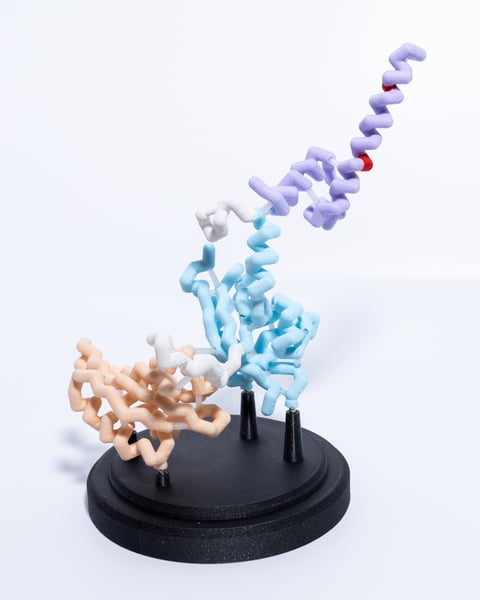
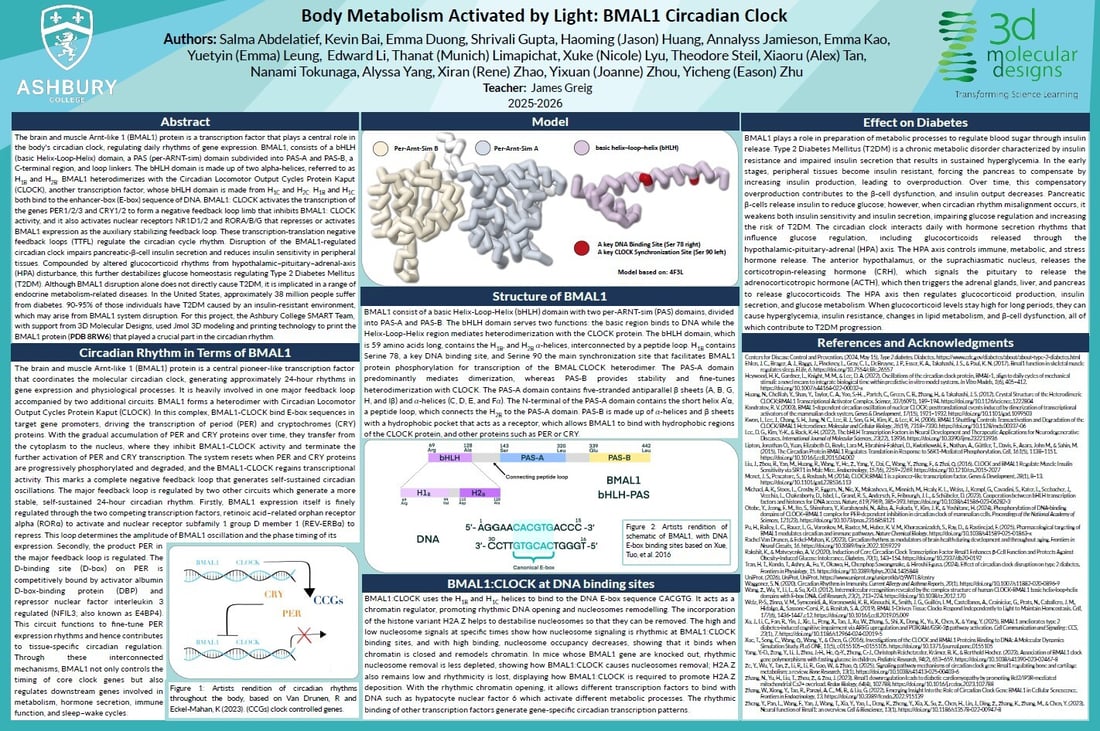
The brain and muscle Arnt-like 1 (BMAL1) protein is a transcription factor that plays a central role in the body's circadian clock, regulating daily rhythms of gene expression. BMAL1, with a total of 387 amino acids, consists of a basic Helix-Loop-Helix (bHLH) domain, a per-ARNT-sim (PAS) domain subdivided into PAS-A and PAS-B, a C-terminal region and loop linkers. The bHLH domain is made up of two alpha-helices, referred to as H1B and H2B. BMAL1 heterodimerizes with the Circadian Locomotor Output Cycles Protein Kaput (CLOCK), the other transcription factor, whose bHLH domain is made from alpha-helices H1C and H2C. H1B and H1C both bind to the enhancer-box (E-box) sequence of DNA. This forms the positive feedback loop, activating the transcription of circadian cycle genes, PER1/2/3, and CRY1/2. These genes form a negative feedback loop limb that inhibits BMAL1: CLOCK activity. BMAL1: CLOCK also activates nuclear receptors NR1D1/2 and RORA/B/G in the auxiliary stabilizing feedback loop, which represses or activates BMAL1 expression. Disruption of the BMAL1-regulated circadian clock impairs pancreatic-β-cell insulin secretion and reduces insulin sensitivity in peripheral tissues. Compounded by altered glucocorticoid rhythms from hypothalamic–pituitary–adrenal-axis (HPA) disturbance, this further destabilizes glucose homeostasis regulating Type 2 Diabetes Mellitus (T2DM). Although BMAL1 alone does not directly cause T2DM, it is implicated in a range of endocrine metabolism-related diseases. In the United States, approximately 38 million people suffer from diabetes. 90-95% of those individuals have T2DM caused by an insulin-resistant environment, which may arise from BMAL1 system disruption. For this project, the Ashbury College SMART Team with support from 3D Molecular Designs used Jmol 3D modeling and printing technology to print the BMAL1 protein (PDB 8RW6) that played a crucial part in the circadian rhythm.
Primary citiation:
-
Pu, H., Bailey, L. C., Bauer, L. G., Voronkov, M., Baxter, M., Huber, K. V. M., Khorasanizadeh, S., Ray, D., & Rastinejad, F. (2025). Pharmacological targeting of BMAL1 modulates circadian and immune pathways. Nature Chemical Biology. https://doi.org/10.1038/s41589-025-01863-x