





BoNT be scared of paralysis, the SNARE gets spared from hydrolysis
Authors: Salma Abdelatief, Thomas Clairand, Asher Friesen, Shrivali Gupta, Edward Huang, Annalyss Jamieson, Emma Kao, and Edward Li
Teacher: James Greig
School: Ashbury College, Ottawa, ON
PBD ID: 1XTF
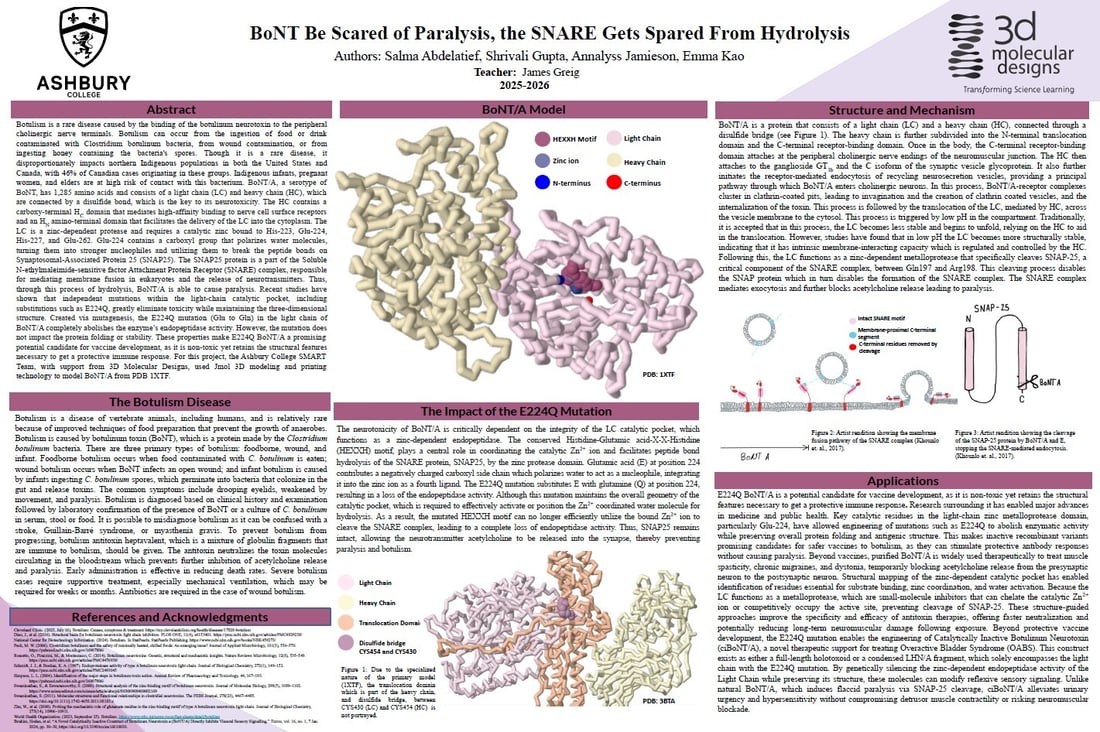
Botulism is a rare disease caused by the binding of the botulinum neurotoxin to the peripheral cholinergic nerve terminals. Botulism can occur from the ingestion of food or drink contaminated with Clostridium botulinum bacteria, from wound contamination, or from ingesting honey containing the bacteria's spores. Though it is a rare disease, it disproportionately impacts northern Indigenous populations in both the United States and Canada, with 46% of Canadian cases originating in these groups. Indigenous infants, pregnant women, and elders are at high risk of contact with this bacterium.
BoNT/A, a serotype of BoNT, is composed of 1,285 amino acids and consists of a light chain (LC) and heavy chain (HC), which are connected by a disulfide bond, which is the key to its neurotoxicity. The HC contains a HC domain that mediates high-affinity binding to nerve cell surface receptors and an HN amino-terminal domain that facilitates the delivery of the LC into the cytoplasm. The LC is a zinc-dependent protease and requires a catalytic zinc to bond to His-223, Glu-224, His-227, and Glu-262.
Glu-224 contains a carboxyl group that polarizes water molecules, turning them into nucleophiles and uses them to break the peptide bonds on Synaptosomal-Associated Protein 25 (SNAP25). The SNAP25 protein is a part of the Soluble N-ethylmaleimide-sensitive factor Attachment Protein Receptor (SNARE) complex, responsible for mediating membrane fusion in eukaryotes and the release of neurotransmitters. Thus, through this process of hydrolysis, BoNT/A is able to cause paralysis. Recent studies have shown that independent mutations within the light-chain catalytic pocket, including substitutions such as E224Q (Glu to Gln), greatly eliminates toxicity while maintaining the protein's three-dimensional structure. This property makes E224Q BoNT/A a promising potential candidate for vaccine development. For this project, the Ashbury College SMART Team, with support from 3D Molecular Designs, used Jmol 3D modeling and printing technology to model BoNT/A from PDB 1XTF.
.jpg?width=600&height=480&name=0D6A9959%20(1).jpg "0D6A9959 (1)")
Primary citiation:
-
Substrate recognition strategy for botulinum neurotoxin serotype A Breidenbach, M.A., Brunger, A.T. (2004) Nature 432: 925-929 PubMed: 15592454