





PrPSC Aspired to have Electrostatic Stability
Authors: Andrew Hamzo, Haoming (Jason) Huang, Kevin Bai, Thanat (Munich) Limapichat, Xiaoru (Alex) Tan, Yicheng (Eason) Zhu, Zhanxu (Leo) Cao, Amanda Muwen Qi, Maggie Q Zhang.
Teacher: James Greig
School: Ashbury College, Ottawa, ON
PBD ID: 3HEQ
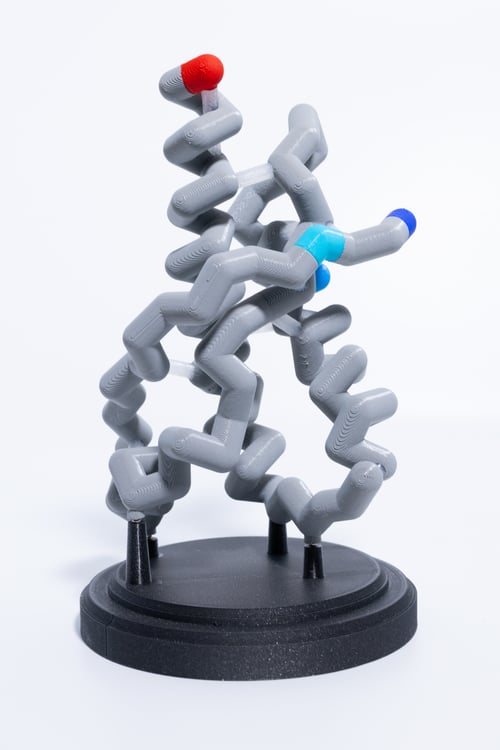
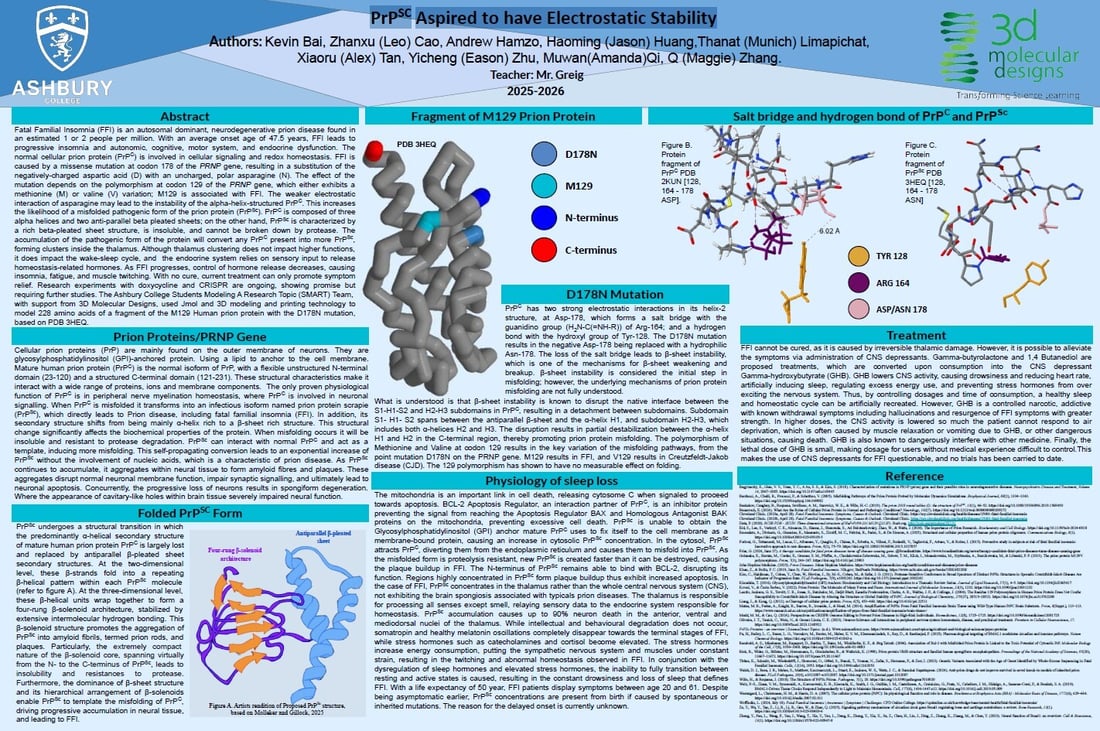
Fatal Familial Insomnia (FFI) is an autosomal dominant, neurodegenerative prion disease found in an estimated 1 or 2 people per million. With an average onset age of 47.5 years, FFI leads to progressive insomnia and autonomic, cognitive, motor system, and endocrine dysfunction. The normal cellular prion protein (PrPC) is involved in cellular signaling and redox homeostasis. FFI is caused by a missense mutation at codon 178 of the PRNP gene, resulting in a substitution of the negatively-charged aspartic acid (D) with an uncharged, polar asparagine (N). The effect of the mutation depends on the polymorphism at codon 129 of the PRNP gene, which either exhibits a methionine (M) or valine (V) variation; M129 is associated with FFI. The weaker electrostatic interaction of asparagine may lead to the instability of the alpha-helix-structured PrPC. This increases the likelihood of a misfolded pathogenic form of the prion protein (PrPsc). PrPC is composed of three alpha helices and two anti-parallel beta pleated sheets; on the other hand, PrPsc is characterized by a rich beta-pleated sheet structure, is insoluble, and cannot be broken down by protease. The accumulation of the pathogenic form of the protein will convert any PrPC present into more PrPsc, forming clusters inside the thalamus. Although thalamus clustering does not impact higher functions, it does impact the wake-sleep cycle, and the endocrine system relies on sensory input to release homeostasis-related hormones. As FFI progresses, control of hormone release decreases, causing insomnia, fatigue, and muscle twitching. With no cure, current treatment can only promote symptom relief. Research experiments with doxycycline and CRISPR are ongoing, showing promise but requiring further studies. The Ashbury College Students Modeling A Research Topic (SMART) Team, with support from 3D Molecular Designs, used Jmol and 3D modeling and printing technology to model 228 amino acids of a fragment of the M129 Human prion protein with the D178N mutation, which is the cause of Fatal Familial Insomnia, based on PDB 3HEQ.
Primary citiation:
-
Lee, S., Antony, L., Hartmann, R., Knaus, K. J., Surewicz, K., Surewicz, W. K., & Yee, V. C.
(2009). Conformational diversity in prion protein variants influences intermolecular
β-sheet formation. The EMBO Journal, 29(1), 251-262.
https://doi.org/10.1038/emboj.2009.333