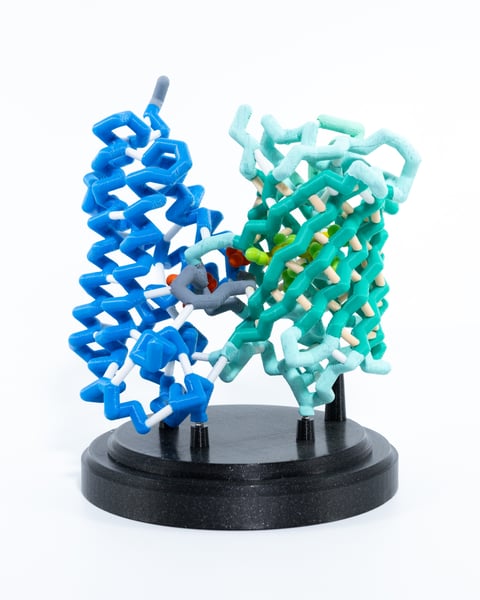




Hypocrates is a fluorescent biosensor that can detect DNA-damaging (pseudo)hypohalous acids (e.g. HOCl, HOBr) produced during inflammatory responses, therefore picking up on areas with an increased risk of numerous diseases, including cancer. The Cedarburg High School SMART (Students Modeling a Research Topic) Team has designed a model of Hypocrates using Jmol and 3D printing technology to study its structure-function relationships. This model highlights important structural features of Hypocrates that can help researchers understand its function. Specifically, Hypocrates consists of a genetically engineered yellow fluorescent protein (cpYFP) embedded within a modified bacterial transcription repressor (NemRC106) that detects (pseudo)hypohalous acids. NemR is the sensor and includes a number of Cys residues, making the protein naturally redox-sensitive. cpYFP is the reporter and contains the typical  -barrel shape of fluorescent proteins, with 11 strands that enclose and protect the chromophore, a modified Thr-Tyr-Gly tripeptide. A conformational change, invoked through a reaction of Cys355 with HOCl, in NemRC106 alters cpYFP’s fluorescence, signaling the presence of (pseudo)hypohalous acids. Future research regarding the ability of Hypocrates to detect (pseudo)hypohalous acids released during inflammatory responses in cells could allow for earlier detection and more effective treatment of cancer.