





Intervention Across the HIV Lifecycle: Entry Inhibition and Post-Infection Treatment
Authors: Bronson, C., Castillo, C., Kaczmarowski, N., Kyrola, S., Phoungphol, L., Pia, B., Ploegert, Z., Riccio, S., Yopp, J.
Teacher: Dan Koslakiewicz
School: Cudahy High School, Cudahy, WI
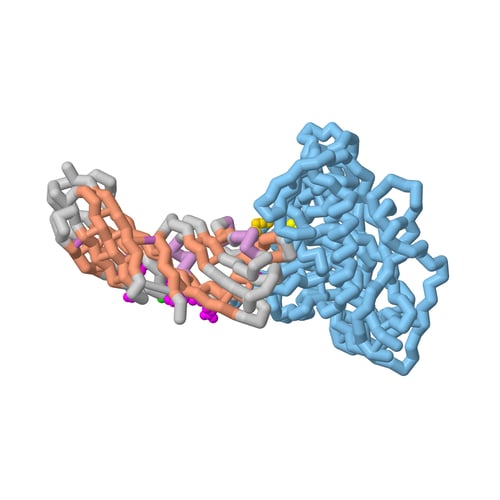
PBD ID: 6L1Y
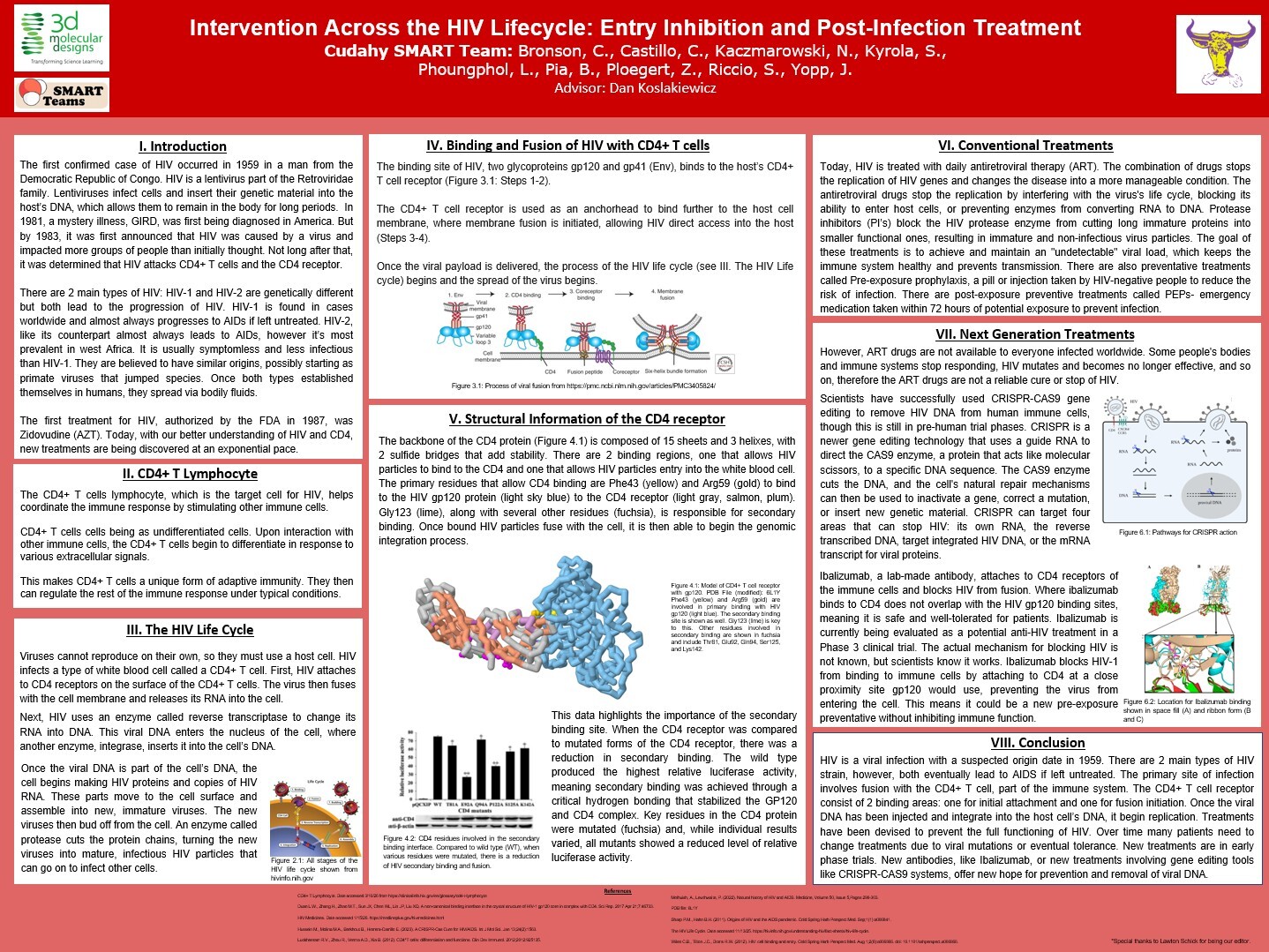
With the first known case of HIV being potentially in 1959, understanding the virus and how to treat it has grown tremendously. Beginning in 1983 with the identification of the HIV virus, it has become known that there are 2 main types of HIV that result in an AIDS diagnosis if left untreated. HIV begins its infection process by attacking the immune system through CD4+ T cells. In order for HIV to infect, there is a 2 part bonding process. The initial bonding occurs between HIV and CD4 where Phe43 plays a role in HIV recognition. Once bound to CD4, a secondary binding mechanism initiates membrane fusion, resulting in the injection of HIV mRNA into the host cell. HIV reverse transcriptase synthesizes HIV DNA, which is integrated into host DNA. The cell is hijacked and turned into a virus producing factory. Data suggests the importance of the secondary binding site. Current treatment for HIV include medications that inhibit various stages of the viral production cycle. Other work to prevent infection to a potential exposure. The goal is to reduce viral loads to undetectable amounts. Over time, patients may no longer respond to medication or the virus mutates, rendering the medication ineffective. A new lab-made antibody may be a solution to preventing infection as it blocks the CD4 receptor without inhibiting other cellular functions. A CRISPR-CAS9 treatment to cut viral nucleic acids is also showing promise in lab tests. With the ever changing HIV landscape, new treatments are a must.
Citations
-
CD4+ T Lymphocyte. Date accessed 3/16/26 from https://clinicalinfo.hiv.gov/en/glossary/cd4-t-lymphocyte
-
Duan L.W., Zhang H., Zhao M.T., Sun JX, Chen WL, Lin JP, Liu XQ. A non-canonical binding interface in the crystal structure of HIV-1 gp120 core in complex with CD4. Sci Rep. 2017 Apr 21;7:46733.
-
HIV Medicines. Date accessed 1/15/26. https://medlineplus.gov/hivmedicines.html
-
Hussein M., Molina M.A., Berkhout B., Herrera-Carrillo E. (2023). A CRISPR-Cas Cure for HIV/AIDS. Int J Mol Sci. Jan 13;24(2):1563.
-
Luckheeram R.V., Zhou R., Verma A.D., Xia B. (2012). CD4⁺T cells: differentiation and functions. Clin Dev Immunol. 2012;2012:925135.
-
Melhuish, A., Lewthwaite, P. (2022). Natural history of HIV and AIDS. Medicine, Volume 50, Issue 5,Pages 298-303.
-
PDB file: 6L1Y
-
Sharp P.M., Hahn B.H. (2011). Origins of HIV and the AIDS pandemic. Cold Spring Harb Perspect Med. Sep;1(1):a006841.
-
The HIV Life Cycle. Date accessed 11/13/25. https://hivinfo.nih.gov/understanding-hiv/fact-sheets/hiv-life-cycle.
- Wilen C.B., Tilton J.C., Doms R.W. (2012). HIV: cell binding and entry. Cold Spring Harb Perspect Med. Aug 1;2(8):a006866. doi: 10.1101/cshperspect.a006866