





WaRPEd Into Darkness: The Gene That Can Change How You See the World
Authors: D. Basurto-Sil, A. Diaz, C. Grams, S. Hughes, E. Jankowski, J. Krueger, M. Minessale, I. San Miguel, E. Wagner, O. Nencka, I. O’Brien, C. McBride, Z. Lavoe, L. Rodriguez, A. Toth, L. Tucker, E. Walker
Teachers: M. Hahn, S. Strandberg
Mentor: Hannah Follett, Dr. Joseph Carroll (Medical College of Wisconsin, Cell Biology, Neurobiology, & Anatomy, Ophthalmology and Visual Sciences, Joint Department of Biomedical Engineering)
School: Divine Savior Holy Angels High School, Milwaukee, WI
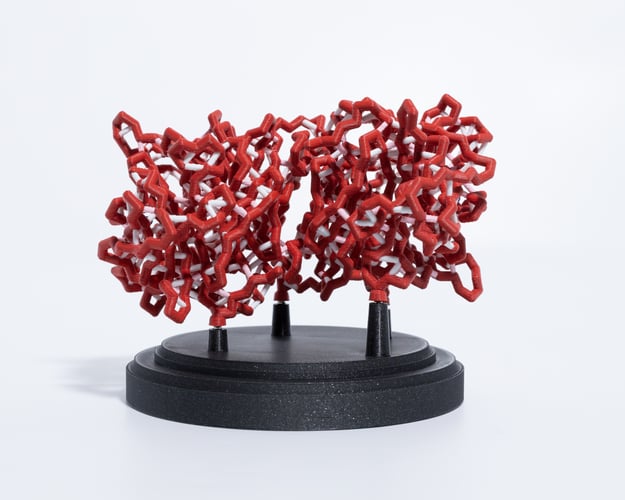
PBD ID: 3FSN
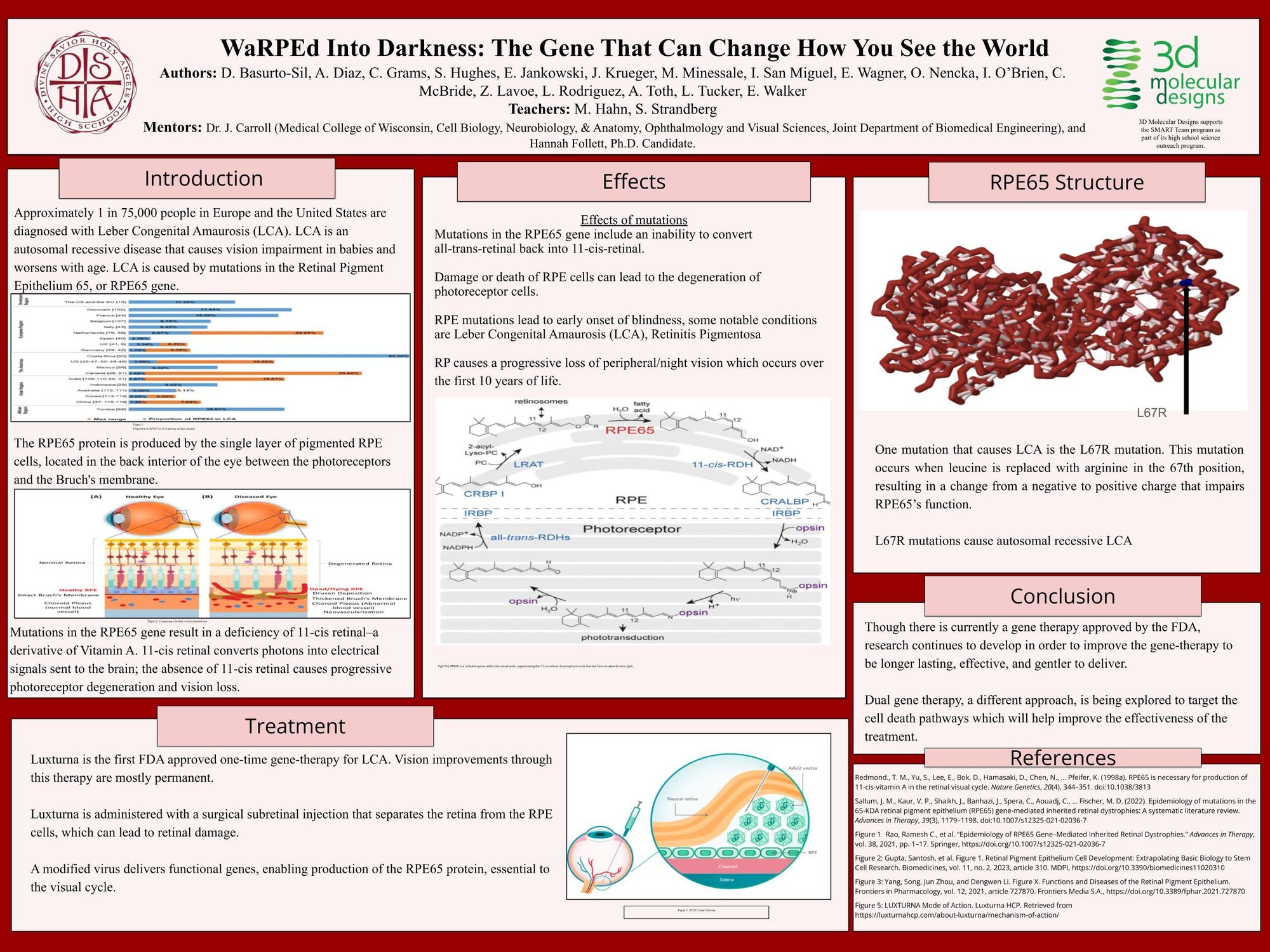
The most common cause of inherited blindness in childhood is Leber Congenital Amaurosis (LCA): an autosomal recessive disease that causes vision impairment in babies and worsens as the child ages. LCA is caused by mutations in the Retinal Pigment Epithelium 65 (RPE65) gene which provides instructions to make the RPE65 protein. RPE65 is produced by the single layer of pigmented RPE cells located in the back-interior of the eye between the photoreceptors and the choroidal blood supply. The RPE65 is a critical enzyme within the visual cycle, regenerating the 11-cis retinal chromophore to its inactive form to absorb more light. The 11-cis-retinal is a derivative of Vitamin A that captures a photon of light, which is converted into a signal that is sent to the brain to process an image. As 11-cis retinal performs this process, it converts into 11-trans retinal, which then interacts with RPE65 so it can be recycled. The cycle continues by returning 11-cis retinal to the photoreceptors. However, mutations in RPE65 result in a deficiency of 11-cis retinal. Congenital loss of chromophore production due to RPE65-deficiency causes progressive photoreceptor degeneration and ongoing vision loss for individuals with LCA. Luxturna is the first FDA approved gene therapy for LCA. While vision improvements through this therapy are mostly permanent, the means of delivering the therapy can lead to retinal damage as gene therapy is injected directly to the eyes. Research continues to develop in order to improve gene therapy.
References
-
Redmond., T. M., Yu, S., Lee, E., Bok, D., Hamasaki, D., Chen, N., … Pfeifer, K. (1998a). RPE65 is necessary for production of 11-cis-vitamin A in the retinal visual cycle. Nature Genetics, 20(4), 344–351. doi:10.1038/3813
-
Sallum, J. M., Kaur, V. P., Shaikh, J., Banhazi, J., Spera, C., Aouadj, C., … Fischer, M. D. (2022). Epidemiology of mutations in the 65-KDA retinal pigment epithelium (RPE65) gene-mediated inherited retinal dystrophies: A systematic literature review. Advances in Therapy, 39(3), 1179–1198. doi:10.1007/s12325-021-02036-7
-
Figure 1: Rao, Ramesh C., et al. “Epidemiology of RPE65 Gene–Mediated Inherited Retinal Dystrophies.” Advances in Therapy, vol. 38, 2021, pp. 1–17. Springer, https://doi.org/10.1007/s12325-021-02036-7
-
Figure 2: Gupta, Santosh, et al. Figure 1. Retinal Pigment Epithelium Cell Development: Extrapolating Basic Biology to Stem Cell Research. Biomedicines, vol. 11, no. 2, 2023, article 310. MDPI, https://doi.org/10.3390/biomedicines11020310
-
Figure 3: Yang, Song, Jun Zhou, and Dengwen Li. Figure X. Functions and Diseases of the Retinal Pigment Epithelium. Frontiers in Pharmacology, vol. 12, 2021, article 727870. Frontiers Media S.A., https://doi.org/10.3389/fphar.2021.727870
-
Figure 5: LUXTURNA Mode of Action. Luxturna HCP. Retrieved from https://luxturnahcp.com/about-luxturna/mechanism-of-action/