





Cephalosporin Resistance within Enterococcus faecalis: How the extracellular domain of PgpH may impact resistance through c-di-AMP hydrolysis regulation
Authors: M. Griffin-Wenzel, M. Puliyelil, A. Bora, A. Desai, S. Gudise, J. Herath, G. Pabbisetty, L. Schmitz, W. Shermach, J. Ticku, J. Zheng
Teacher: M. Griffin-Wenzel
Mentor: M. Puliyelil (Department of Microbiology & Immunology, Medical College of Wisconsin, Milwaukee, WI)
School: Germantown High School, Germantown, WI
PBD ID: 4S1C
Cephalosporins are widely used antibiotics for the treatment of bacterial infections. Their mechanism of action involves disruption of bacterial peptidoglycan cell walls, leading to cell wall stress. In Enterococcus faecalis, resistance to cephalosporins is influenced by a variety of factors. One factor is thought to be the nucleotide second messenger called cyclic di-AMP (c-di-AMP). c-di-AMP has been shown to play a role in regulating many cellular functions, including osmoregulation and virulence. This nucleotide signaling molecule is regulated by phosphodiesterases, including the PgpH protein, whose cytoplasmic HD domain hydrolyzes c-di-AMP. Changes in the expression of PgpH can lead to deregulation of intracellular c-di-AMP levels and altered cephalosporin resistance. Studying the extracellular domain of PgpH and its mutations may inform the development of novel strategies to counteract antibiotic resistance and improve clinical outcomes.
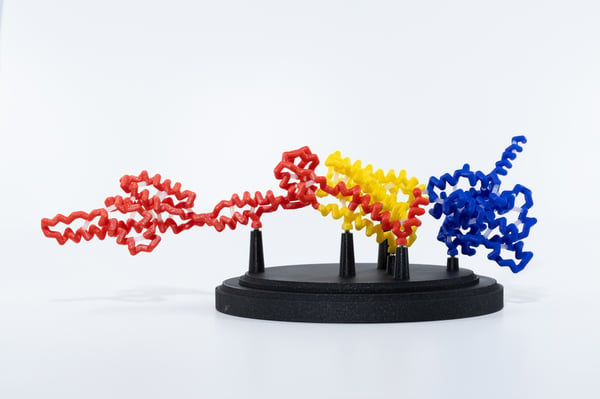
Structurally, PgpH consists of three domains: a large extracellular domain, a seven-transmembrane helix bundle, and a cytoplasmic HD domain that catalyzes the hydrolysis of c-di-AMP to 5′-pApA. We used Jmol to design a 3D-printed model of all three PgpH domains, enabling removal of the extracellular domain to visualize and compare protein variants. To investigate how the extracellular domain of PgpH influences c-di-AMP levels and cephalosporin resistance in E. faecalis, Dr. Dusanka Djoric and Milcah Puliyelil, used mutant cells lacking PgpH to generate PgpH variants with defined deletions within the extracellular domain and expressed these constructs in E. faecalis. These strains were evaluated using growth assays (a scientific method to measure the increase in size or number of living organisms or their components, such as cells), cephalosporin susceptibility testing, via minimum inhibitory concentration assays and c-di-AMP concentration assays via ELISA to determine how changes in the extracellular domain alter PgpH function during antibiotic-induced cell wall stress. Preliminary experiments demonstrate that loss of PgpH function leads to elevated intracellular c-di-AMP levels and increased resistance to cephalosporins, supporting a role for PgpH in regulating this signaling pathway under cell wall stress. Mutations in PgpH lead to elevated intracellular c-di-AMP levels, which promote resistance to cephalosporin antibiotics. This resistance enables bacteria to survive treatments that would normally be effective, allowing infections to persist and spread within the host. Consequently, patients face an increased risk of severe and difficult-to-treat infections, including urinary tract and bloodstream infections. Engineered deletion variants of the extracellular domain will enable identification of regions required for sensing cell wall damage and modulating downstream cellular responses. Together, these approaches aim to clarify the role of the PgpH extracellular domain in coordinating c-di-AMP–mediated cephalosporin resistance in E. faecalis. This work will provide insight into how domain-specific functions contribute to the activity of the protein as a whole and expand upon prior studies, which have largely focused on the effects of PgpH mutations in Listeria species.
.jpg?width=1067&height=800&name=SMART%20Team%20Poster%202026%20(3).jpg "SMART Team Poster 2026 (3)")
References
-
Kundra, Shivani, et al. “C-Di-AMP Is Essential for the Virulence of Enterococcus Faecalis.” Infection and Immunity, vol. 89, no. 11, 23 Aug. 2021, https://doi.org/10.1128/iai.00365-21. Accessed 15 Oct. 2025.
-
Puliyelil, Milcah, et al. “Studying the role of the PgpH extracellular domain on c-di-AMP levels and cephalosporin resistance in Enterococcus faecalis.” Medical College of Wisconsin, August 2025.
-
TuAnh Ngoc Huynh, et al. An HD-Domain Phosphodiesterase Mediates Cooperative Hydrolysis of C-Di-AMP to Affect Bacterial Growth and Virulence. Vol. 112, no. 7, 17 Feb. 2015, https://doi.org/10.1073/pnas.1416485112. Accessed 16 May 2023.