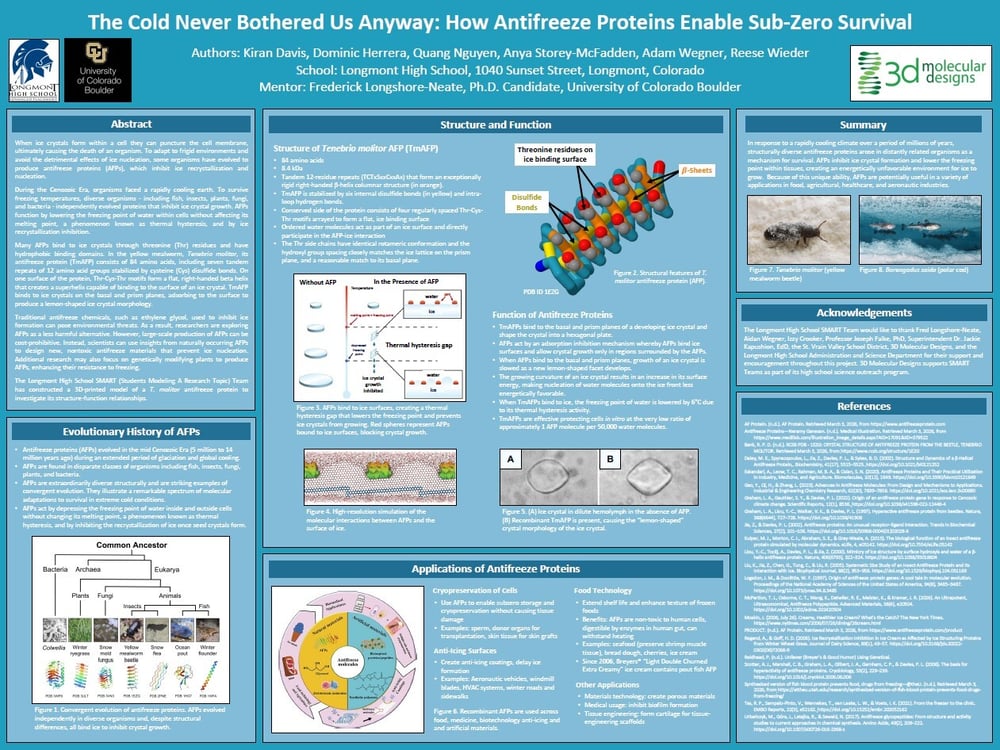




The Cold Never Bothered Us Anyway: How Antifreeze Proteins Enable Sub-Zero Survival
Authors: Kiran Davis, Dominic Herrera, Quang Nguyen, Anya Storey-McFadden, Adam Wegner, Reese Wieder
Teacher: Chris Chou, Dick Martyr
Mentor: Frederick Longshore-Neate, Ph.D. Candidate, Department of Biochemistry, University of Colorado Boulder
School: Longmont High School, Longmont, CO
PBD ID: 1EZG
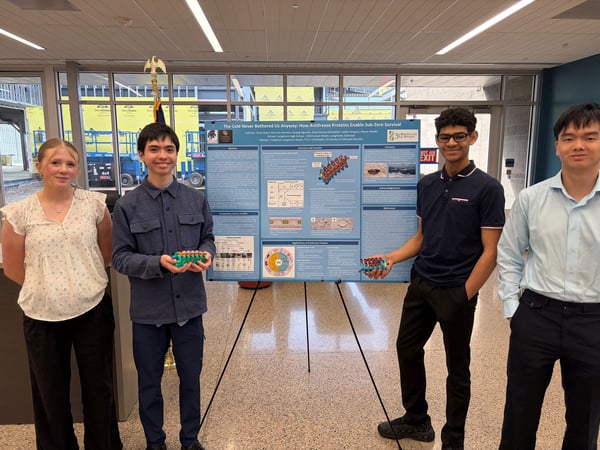
When ice crystals form within a cell they can puncture the cell membrane, ultimately causing the death of an organism. To adapt to frigid environments and avoid the detrimental effects of ice nucleation, some organisms have evolved to produce antifreeze proteins (AFPs), which inhibit ice recrystallization and nucleation. During the Cenozoic Era, organisms faced a rapidly cooling earth. To survive freezing temperatures, diverse organisms - including fish, insects, plants, fungi, and bacteria - independently evolved proteins that inhibit ice crystal growth. AFPs function by lowering the freezing point of water within cells without affecting its melting point, a phenomenon known as thermal hysteresis, and by ice recrystallization inhibition. Many AFPs bind to ice crystals through threonine (Thr) residues and have hydrophobic binding domains. In the yellow mealworm, Tenebrio molitor, its antifreeze protein (TmAFP) consists of 84 amino acids, including seven tandem repeats of 12 amino acid groups stabilized by cysteine (Cys) disulfide bonds. On one surface of the protein, Thr-Cys-Thr motifs form a flat, right-handed beta helix that creates a superhelix capable of binding to the surface of an ice crystal. TmAFP binds to ice crystals on the basal and prism planes, adsorbing to the surface to produce a lemon-shaped ice crystal morphology. Traditional antifreeze chemicals, such as ethylene glycol, used to inhibit ice formation can pose environmental threats. As a result, researchers are exploring AFPs as a less harmful alternative. However, large-scale production of AFPs can be cost-prohibitive. Instead, scientists can use insights from naturally occurring AFPs to design new, nontoxic antifreeze materials that prevent ice nucleation. Additional research may also focus on genetically modifying plants to produce AFPs, enhancing their resistance to freezing. The Longmont High School SMART (Students Modeling A Research Topic) Team has constructed a 3D-printed model of a T. molitor antifreeze protein to investigate its structure-function relationships.
.jpg?width=500&height=400&name=0D6A9951%20(1).jpg "0D6A9951 (1)")