





Modeling the Arginine-Facilitated Hydrogen Bond Network among Phenylalanine Hydroxylase Dimers
Authors: Jessica B. Sakash Replogle, Sophia Carazo, Meghana Curran, Caitlyn Ferrer, Zezzie Imperial, Zaina Kamran, and Beatrice Nery
School: Summit Country Day School, Cincinnati, OH
PBD ID: 2PAH
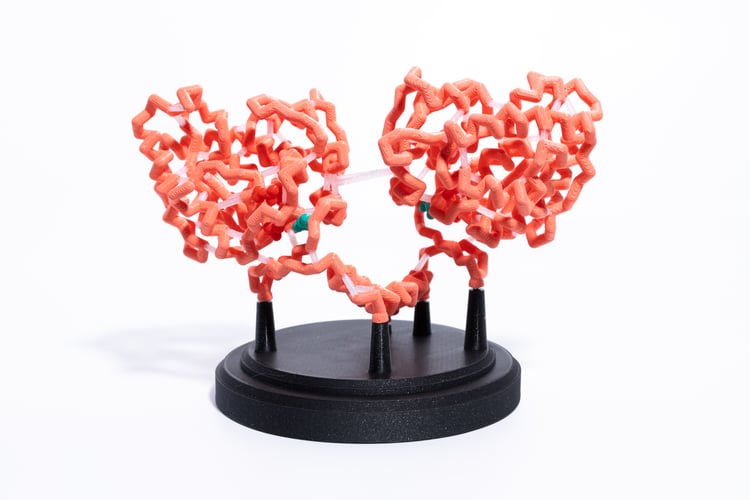
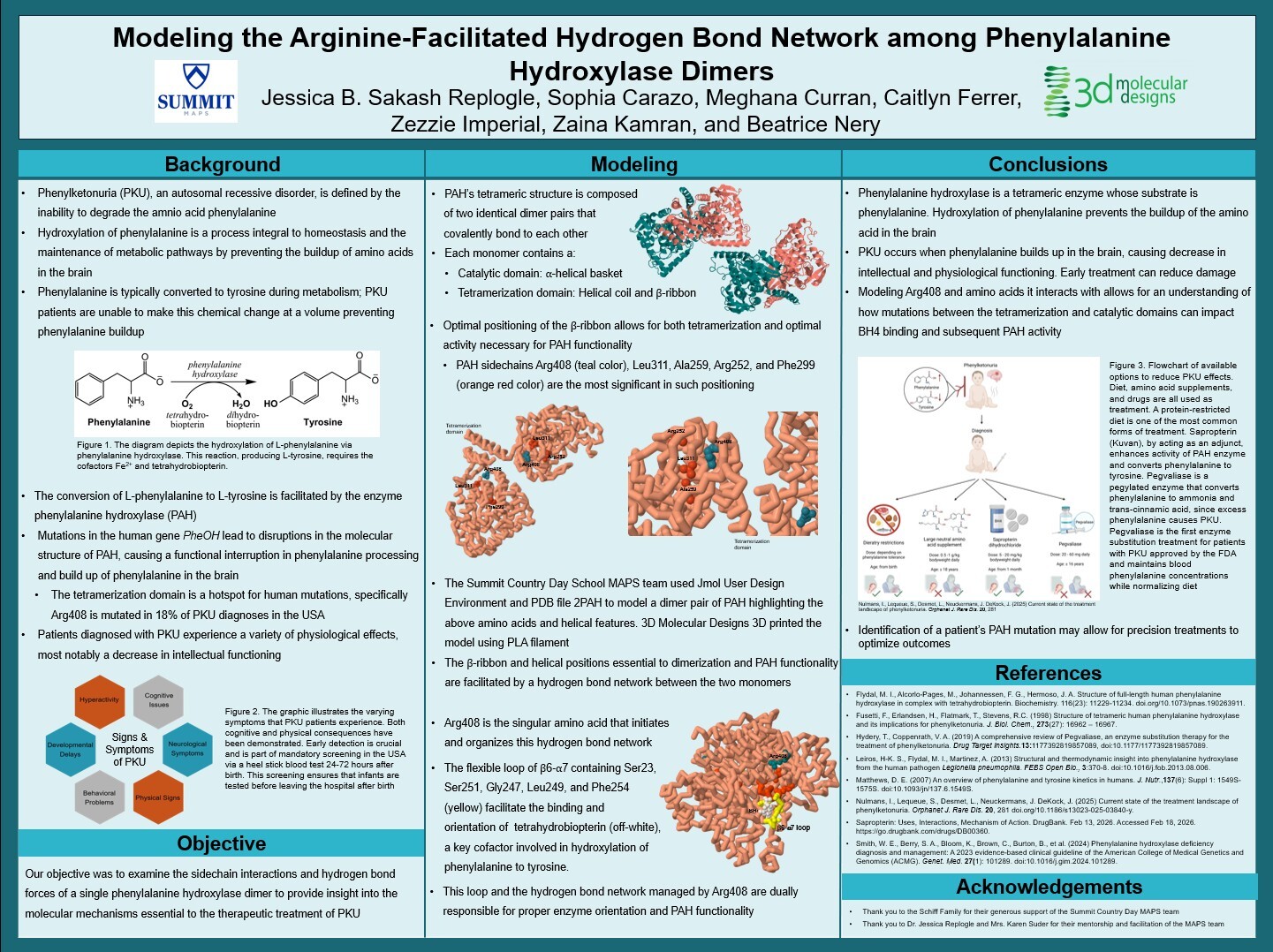
Phenylketonuria (PKU) is an autosomal recessive disorder classified by the inability to hydroxylate L-phenylalanine to L-tyrosine, the process responsible for the degradation of the amino acid phenylalanine. As an amino acid integral to many metabolic pathways, excess phenylalanine cannot remain in a dehydroxylated form without serious interruptions in homeostasis. PKU in humans is caused by mutations in the PheOH gene that interferes with the molecular structure of phenylalanine hydroxylase (PAH), an enzyme in the L-phenylalanine to L-tyrosine hydroxylation pathway. Atypical folding of PAH as a result of these mutations produces a buildup of phenylalanine in the brain, causing intellectual impairment. Patients diagnosed with PKU must begin a strict protein-reduced diet immediately after diagnosis to mitigate the accumulation of L-phenylalanine and the resulting loss of cognitive function. Modern testing techniques allow PKU to be identified early, but diet intervention only slows side effects. However, development of additional therapeutic strategies requires further knowledge about the molecular mechanisms behind PAH’s tetrameric structure. The Summit Country Day School 3D Molecular Designs SMART Team used 3-D modeling and printing technology to examine the structure- function relationship between one pair of PAH dimers. The monomer is characterized by the α-helical basket in the catalytic domain and a b-ribbon plus a long helical coil tetramerization domain. By highlighting the amino acids Arg408, Leu311, Ala259, Arg252, and Phe299 in our model, we represent the amino acids that are most responsible for the optimal positioning of the b-ribbon of the tetramerization domain next to the catalytic domain. Maintaining the characteristics of the β-ribbon is significant because the hydrogen bond network facilitates optimal orientation of the catalytic domain for activity of the enzyme. Hence, mutations in these sidechain locations produce PAH structural changes that impair the L-phenylalanine to L-tyrosine hydroxylation pathway. This region has structural importance since mutations of these amino acids are associated with a severe PKU phenotype. In modeling one PAH dimer interface, we learn more about the amino acids most involved in maintaining catalytic activity and how such insight could lead to the improvement of future PKU treatments.
References
-
Flydal, M. I., Alcorlo-Pages, M., Johannessen, F. G., Hermoso, J. A. Structure of full-length human phenylalanine hydroxylase in complex with tetrahydrobiopterin. Biochemistry. 116(23): 11229-11234. doi.org/10.1073/pnas.190263911.
-
Fusetti, F., Erlandsen, H., Flatmark, T., Stevens, R.C. (1998) Structure of tetrameric human phenylalanine hydroxylase and its implications for phenylketonuria. J. Biol. Chem., 273(27): 16962 – 16967.
-
Hydery, T., Coppenrath, V. A. (2019) A comprehensive review of Pegvaliase, an enzyme substitution therapy for the treatment of phenylketonuria. Drug Target Insights.13:1177392819857089, doi:10.1177/1177392819857089.
-
Leiros, H-K. S., Flydal, M. I., Martinez, A. (2013) Structural and thermodynamic insight into phenylalanine hydroxylase from the human pathogen Legionella pneumophila. FEBS Open Bio., 3:370-8. doi:10.1016/j.fob.2013.08.006.
-
Matthews, D. E. (2007) An overview of phenylalanine and tyrosine kinetics in humans. J. Nutr.,137(6): Suppl 1: 1549S-1575S. doi:10.1093/jn/137.6.1549S.
-
Nulmans, I., Lequeue, S., Desmet, L., Neuckermans, J. DeKock, J. (2025) Current state of the treatment landscape of phenylketonuria. Orphanet J. Rare Dis. 20, 281 doi.org/10.1186/s13023-025-03840-y.
-
Sapropterin: Uses, Interactions, Mechanism of Action. DrugBank. Feb 13, 2026. Accessed Feb 18, 2026. https://go.drugbank.com/drugs/DB00360.
-
Smith, W. E., Berry, S. A., Bloom, K., Brown, C., Burton, B., et al. (2024) Phenylalanine hydroxylase deficiency diagnosis and management: A 2023 evidence-based clinical guideline of the American College of Medical Genetics and Genomics (ACMG). Genet. Med. 27(1): 101289. doi:10.1016/j.gim.2024.101289.