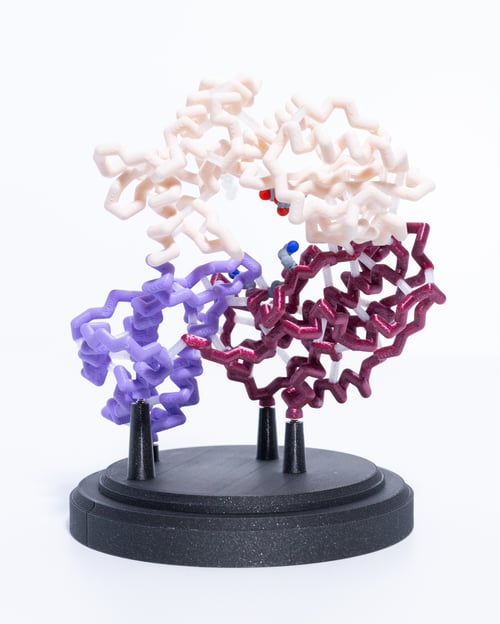




Extending Chromosome Ends: A Structural Look at Telomerase Reverse Transcriptase
Authors: BradyParra, Emily Winter, Ibrahim Abdullah, Avery Wiens, Rujula Puranik, Phinehas Nagy, Kate Deardorff
Teacher: Eric Kessler
School: Blue Valley High School, Stilwell, KS
PBD ID: 3DU6
Natural constraints in the process of DNA replication result in the shortening of telomeres, the ends of linear chromosomes, through each round of synthesis during cell division. Molecular mechanisms evolved, in parallel, to maintain chromosome length and integrity. The telomerase reverse transcriptase (TERT), whose structure, from the flour beetle, Tribolium castaneum, was reported in 2008, is central to these mechanisms. The Blue Valley Center for Advanced Professional Studies (CAPS) 2025-26 SMART (Students Modeling a Research Topic) Team, with the support of the Center for BioMolecular Modeling, modeled the TERT protein to explore the structural components that result in the maintenance of the chromosome ends. Telomerase is a ribonucleoprotein complex containing an RNA component (TERC), the catalytic protein subunit TERT, and multiple accessory proteins. TERT contains three domains: the RNA-binding domain (TRBD), reverse transcriptase (RT) domain, and the C-terminal extension (CTE). Overall, the subunit folds into a ring structure. The highly conserved TRBD contains an indented surface where the RNA template within TERC used for DNA reverse transcription is bound. The RT and CTE domains collectively contain three subdomains, the palm, fingers, and thumb, which hold the chromosome telomere, coordinate the RNA template with the 3’ end of the telomere, and catalyze the extension of DNA repeats that lengthen the chromosome. The active site, located within RT, contains three negatively charged aspartic acid residues which catalyze the phosphodiester bond formation between the 3’ hydroxyl group of the DNA primer (telomere end) and incoming dNTPs, through a two-metal ion mechanism. Neighboring residues coordinate the telomere, RNA template, and free nucleotides for extension. The ring’s interior surface includes numerous basic lysine residues, responsible for telomere binding, and accommodates a species-specific number of nucleotide bases. In mammals, a standard sequence, TTAGGG, is repeatedly added to the telomere end to maintain its appropriate length. During development in multicellular organisms, telomerase is actively expressed but becomes dormant in most differentiated adult somatic cell types. In many cancers, telomerase is overexpressed, facilitating the immortalization of mutated and rapidly dividing cells. In contrast, reduced expression of telomerase contributes to telomere shortening and aging-associated cellular decline.