





Genetic Codon Charts Resource Guide
A Classroom Resource for Teaching the Central Dogma
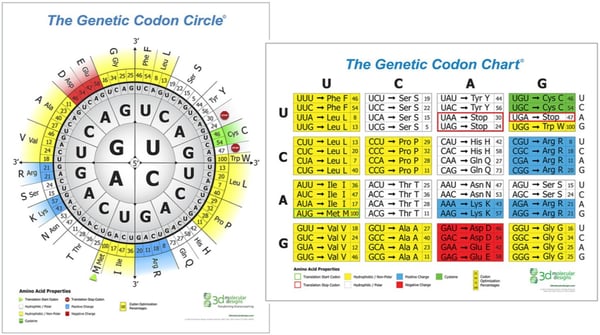
The Genetic Codon Circle & Chart helps students visualize how the sequence of nucleotides in mRNA is translated into amino acids, and ultimately, into proteins. This visual makes it easier for students to understand the genetic code as more than just letters—it becomes a system of meaning tied directly to structure and function.
Using the Codon Circle & Chart in Your Classroom
- Scaffold new concepts: Introduce the Circle and Chart when teaching transcription and translation to help students connect codons with their amino acid products.
- Highlight chemical properties: The color-coding system emphasizes the similarities and differences between amino acids, reinforcing how side chain properties influence protein folding.
- Apply to problem-solving: Use the Circle and Chart in activities where students translate mRNA sequences, investigate mutations, or model protein folding.
- Promote lasting understanding: Because the Circle and Chart use the same color scheme as other 3D Molecular Designs’ kits, students will consistently reinforce their knowledge across multiple activities.
How to Interpret the Codon Circle
- Follow the sequence: Begin at the center of the circle with the first base, then move outward through the second and third bases to determine the codon.
- Find the match: Each codon leads directly to its corresponding amino acid.
- Interpret properties: Colors indicate the chemical nature of each amino acid.
How to Interpret the Codon Chart
- Find the first base: Begin at the leftmost column of the chart. You will read along this row.
- Find the second base: Go to the intersection of your first base and the corresponding column of your second base. This box provides all possible combinations for your third base.
- Find the third base: Scan each row to match your third base. The amino acid is then represented by the three-letter and one-letter abbreviations.
- Interpret properties: Colors indicate the chemical nature of each amino acid.
How to Interpret the Codon Circle
-
Yellow – Hydrophobic amino acids
- White - Polar amino acids
- Red - Acidic amino acids
- Blue - Basic amino acids
- Green - Cysteines
This consistent color scheme matches 3D Molecular Designs’ most popular kits.
Teaching Tip
Encourage students to use the circle while modeling amino acid sequences or analyzing mutations. Seeing chemical properties highlighted by color reinforces critical thinking about protein folding and function.
Extend the Learning
Pair this codon circle with classroom-tested modeling kits from 3D Molecular Designs:
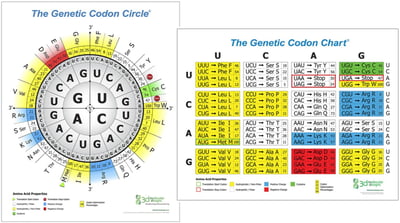
Genetic Codon Posters – Laminated posters promote a seamless connection between the triplet codon in mRNA and the chemical property of the amino acid it encodes
/AASK-MTU%201.jpg?width=300&height=240&name=AASK-MTU%201.jpg "AASK-MTU 1")
Amino Acid Starter Kit© – Explore the chemical properties of amino acids
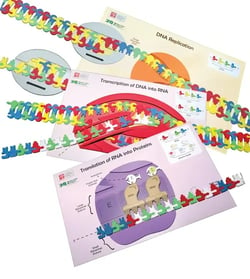
Flow of Genetic Information Kit© – Make sense of the Central Dogma as students model translation, transcription, and replication
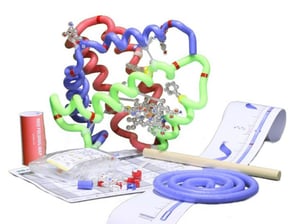
ß-Globin Folding Kit© – Investigate how amino acid sequence drives protein structure
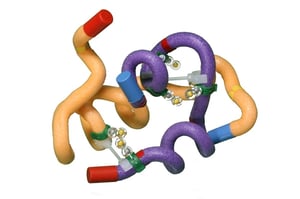
Insulin mRNA to Protein Kit© – Connect transcription, translation, and protein folding
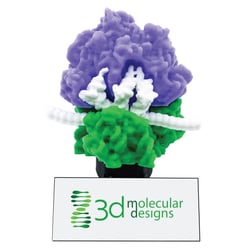
AR-Enhanced Ribosome Translation Micro-Model - Scan the integrated QR code to unlock an augmented reality (AR) animation demonstrating the ribosome's critical role in translating mRNA into protein
These hands-on resources encourage active learning and help students build a robust understanding of molecular biology concepts.
Find more free teaching resources and classroom kits at 3dmoleculardesigns.com