
Skip to content
header-top-2

SMART Teams

Students Modeling A Research Topic

7P0A0621

Welcome to the SMART Teams Protein Modeling Program!

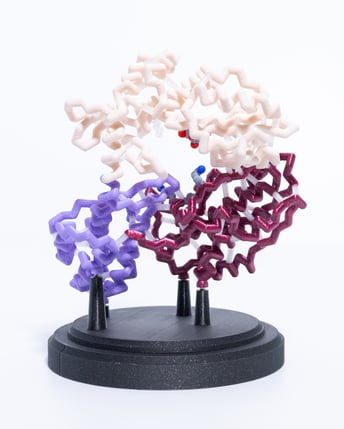
In SMART Teams, small groups of students, led by an educatorfacilitator, research, design, and present a 3D protein model that tells a clear structurefunction story. Students will read a research paper, use protein structure data to “design” and 3D print a model of the protein, and use the model as the organizing center for telling the team’s structure-function story through an abstract, poster, and capstone presentation. 

Why SMART Teams?

SMART Teams helps students:

  • Step beyond the textbook by reading primary research and exploring real protein structures.
  • Use molecular visualization tools to design a simplified, storydriven 3D model.
  • Communicate their findings using the model as the focal point in a poster or conference presentation.

You guide your students as they work through a structured fourphase process that keeps the model design at the heart of the experience.

7P0A0947

The SMART Team Phases

In the Planning Phase, you’ll decide how your SMART Team project will take shape, choose your research direction, and set your major milestones so the model comes first and the abstract and poster build from it.

On this page, you’ll find an overview of the Planning Phase, what your registration includes, and a suggested timeline for organizing your team’s work around the capstone experience.


In the Training Phase, you’ll learn the basics of protein structure, practice reading a science research paper, explore an example protein story, and design a model for 3D printing as a rehearsal for the Protein Story Phase.

On this page, you’ll find the full Training Phase overview, the four section topics, and recommended models and resources to help your team get comfortable with SMART Team modeling before moving into the next phase.

In the Protein Story Phase, you’ll study a specific protein, explore how its structure supports its function, and turn that research into a 3D-printed model for your capstone presentation.

On this page, you’ll find the Protein Story Phase framework, including how to research the paper, design the model, draft the abstract and poster around it, and present your work with the model as the centerpiece.

In the Capstone Experience Phase, you’ll present your protein story to an audience, using your model, poster, and abstract to communicate the science clearly and confidently.

On this page, you’ll find guidance for preparing a scientific poster and abstract, exploring presentation options like conferences or symposiums, and creating a polished capstone experience that puts your model at the center of the story.


The Protein Story Phase Framework

Within the Protein Story Phase, SMART Teams work through the following steps.

Step 1 - Research the Paper and Protein

Students select a molecular story or research mentor, then read and discuss the primary literature. Teams identify the key biological question, the protein’s role, and the structural features that matter for their story.

Step 2 - Design the Model

Using Jmol and 3D Molecular Designs’ molecule builder, teams explore the protein structure in 3D and decide how to visually simplify it. They choose displays, hide nonessential atoms, and apply color schemes that highlight the features most important to their structurefunction story.

Step 3 - Draft Abstract and Poster Around the Model

Once the model design is defined, teams begin drafting their abstract and poster using the model as the outline. Text, figures, and talking points are built to explain what the model shows and why those structural features matter.

Step 4 - Present with the Model as Centerpiece

At the capstone event, students present “with the model in hand,” using it as the main storytelling tool rather than a background prop. In the capstone project, the model is the centerpiece; the poster, abstract, and discussion are organized to walk the audience through the model and the underlying research questions.


What Does it Mean to "Design" a Protein Model?

Creating a physical model of a protein structure is a key component of the SMART team program.

But what does it really mean to "design" a protein model? It means you explore a protein structure in a molecular visualization program, and then simplify the way the protein is visually displayed to make the key features of the protein more obvious to help communicate your molecular story.  

This can mean hiding some atoms that are not important for your protein story, changing the display format of certain parts of your protein structure, or changing colors to better highlight the most important parts of the protein structures. 

0D6A9940

Modeling Resources

starburstTrainingGuide

On the Modeling Resources page, you’ll find the digital tools that support 3D Molecular Designs’ physical models and help students and teachers create their own 3D-printed molecular models and interactive web pages.

This page highlights key resources like the Jmol Training Guide, JUDE, the Small Molecule Maker, and the Jmol Exploration Web Page Creator, along with brief descriptions of what each tool is used for.


Register Your Team Today!

Registering your SMART Team gives you immediate access to:

  • All 4 phases of the SMART Teams modeling program, in a clearly sequenced timeline.
  • Modeling tools and resources, including a Jmol explorer page and molecule builder.
  • 3DMD staff support with model design, abstract development, and poster preparation, aligned to each phase of the process.
  • A fourcolor 3D print of your team’s finalized model design.
  • Access to selected molecular stories (e.g., Insulin, Aquaporin, Antibodies) for teams without a research mentor.
  • Opportunities to present at events such as ASBMB undergraduate poster sessions and 3D Molecular Designs’ SMART Team Symposium when modelfirst milestones are met.
  • Opportunity for SMART Teams to publish their research on 3D Molecular Design's website

This phased support is designed to help educators lead teams efficiently while keeping the model at the center of the narrative from start to finish.


Explore the archive of previous SMART Teams projects. These teams presented their capstone projects at ASBMB conferences and 3D Molecular Designs SMART Team Symposiums.

Read these publications from former and current staff (specifically on SMART teams), articles about SMART teams, and other professional journal articles to learn more about the benefits of modeling!


longmont smart 2
proflearn_studentenrich_Timsmartteam (1)-1
Brown Deer High School SMART Team
7P0A0540
7P0A9920
7P0A1477
7P0A0583
photo6
7P0A9911
7P0A9914
7P0A9900
7P0A0695
7P0A9942
7P0A1522
7P0A0653
7P0A0621
7P0A9929

What Are Students Saying About SMART Teams? 

"I love SMART Teams!!!! As a senior, I feel really prepared for college-level courses and I can confidently engage with the scientific community. I can also communicate research and scientific findings in a clear and comprehensive way to anyone. Thanks!!" 

"It gave me a better idea of how I may want to be involved in the scientific community in the future." 

"The SMART Teams program has taught me the importance of communication and modeling not only within the scientific community but as general life skills. It also showed me how to have an open mind and be willing to learn about others' projects and molecules of interest. Last, the SMART Team program has taught me the importance of actively participating in the scientific community, being professional, and having the ability to take something complex and put it into simpler yet accurate terms." 

"I have changed my mind about what I want to go to college for. Coming into the SMART team program, I wanted to be a mechanic. I now want to be a nurse or physician assistant." 

*SMART Teams was previously run by the Center for BioMolecular Modeling (CBM). The CBM merged with its close partner organization, 3D Molecular Designs, LLC, on Oct. 1, 2022.