





WE2 Model: Wonder, Explore, Explain
A learner-centered modeling framework that begins with wonder and keeps models at the center of every phase of learning — not just the last one.
A Framework Built Around the Model, Not Around the Lesson
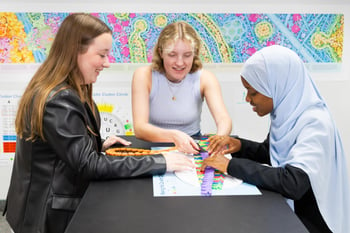
WE² Model (Wonder, Explore, Explain) is our learner-centered framework for using foundational models to support sensemaking in science. Instead of treating models as a final product at the end of a unit, WE² Model starts with wonder, invites exploration, and uses models throughout instruction so learners can make their ideas visible and revise them over time.
The framework came out of 25 years of federally funded work developing models for health and molecular science topics. Along the way, a handful of our models kept outperforming the rest — not because they showed more, but because teachers could take them in more directions. WE² Model is our attempt to name what those models make possible, and to give educators a repeatable way to do it.
Foundational Models at the Center
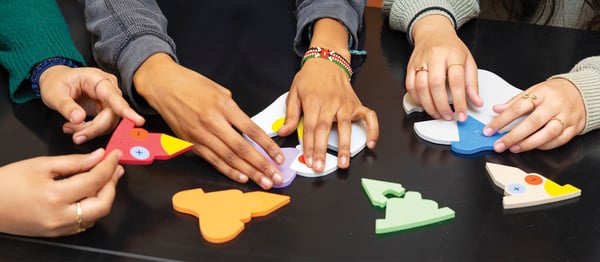
Some models are so engaging, versatile, and thoughtfully designed that they become the starting point for many different learning journeys. We call these foundational models: interactive, typically tactile representations with a low threshold and a high ceiling that support multiple objectives, levels, and storylines. When learners begin with a foundational model instead of a diagram or definition, they enter from a shared place of play and observation, regardless of their prior knowledge.
A foundational model is an interactive model with a low threshold and high ceiling that students can use throughout the learning cycle for multiple learning objectives.
Foundational vs. Traditional Models
| Foundational Models | Traditional Models | |
|
When they're used |
Integral to every phase of the learning cycle | Used to inform, or as the end product of the cycle |
| What it takes to start | Low threshold — learners engage before they have the vocabulary | Vocabulary-dependent, requiring a conceptual background before the model makes sense |
| What learners do | Observe, discover, and generate questions through play | Receive specific features and ideas, with limited room for discovery |
| How they think | Divergent — learner wondering drives direction | Convergent — learners are expected to arrive at a particular set of features |
| How far they go | Many objectives across many levels, so the ceiling stays high | A single narrative or learning pathway |
Wonder: Starting with Learners' Questions
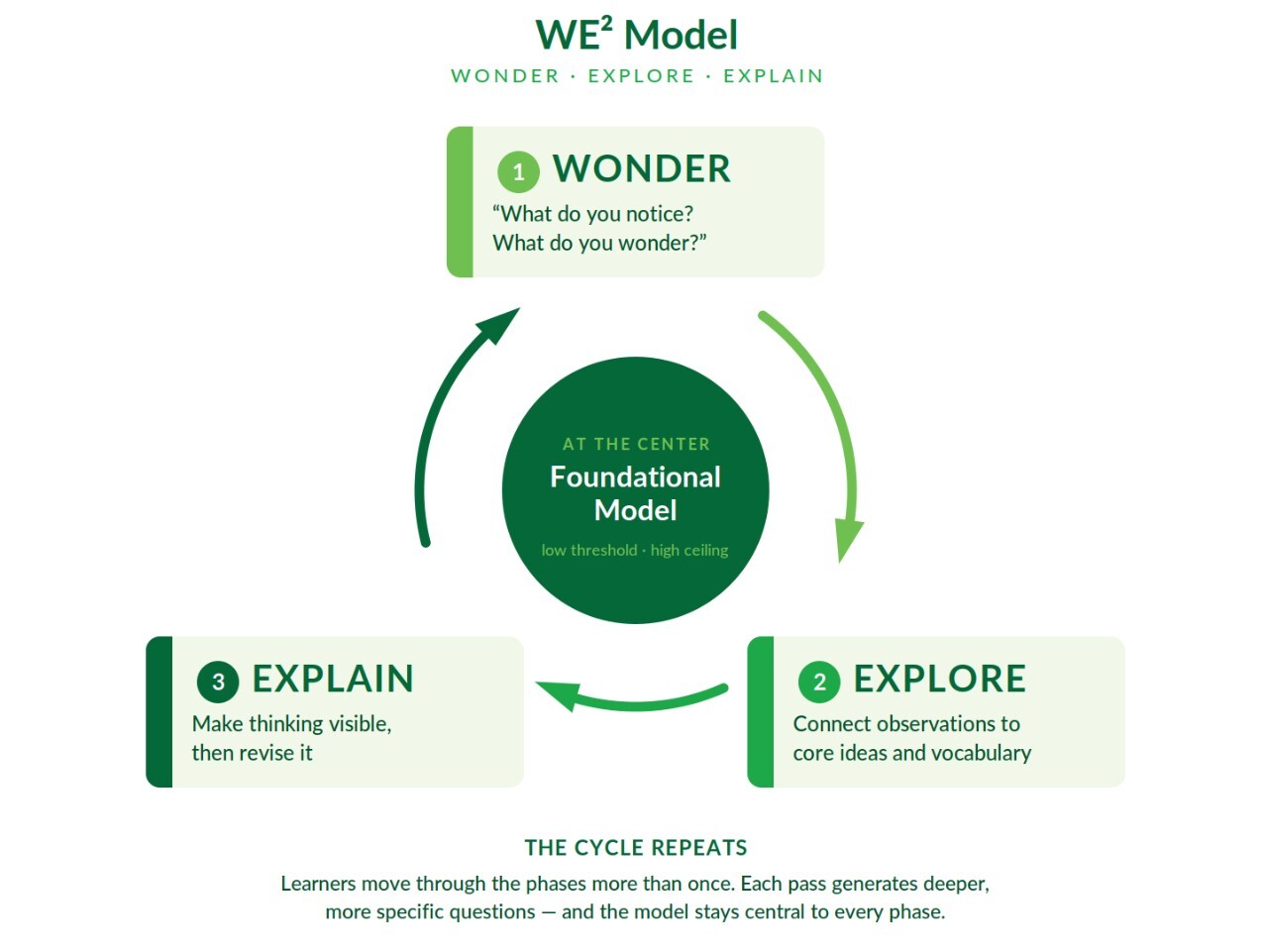
WE² Model begins with Wonder. Learners first interact with a foundational model through play and open-ended observation, asking "What do you notice? What do you wonder?" Wonder is intentionally non-evaluative and grounded in a shared model, which helps reduce risk, elevates more voices, and encourages divergent thinking. This phase connects emotion, curiosity, and early sensemaking, setting up deeper inquiry.
This is where WE² Model differs most from the frameworks you already use. The 5E model begins at Engage — the teacher's move, designed to capture attention and point it somewhere. WE² Model begins at Wonder — the learner's move, with no predetermined destination. It's a small change in wording and a large change in who owns the first question of the lesson.
The first step in other frameworks is also the point at which learners are usually asked to demonstrate knowledge they don't yet have. In the WE2 Model framework, everyone is looking at the same object, no one needs the vocabulary to participate. A student who notices that one part of the model seems to push another part away has made a real scientific observation, whether or not they can say "partial charge."
Wonder is not decoration. Researchers describe it as engaging learners "on all levels — emotionally, intellectually, aesthetically, and strongly existentially" (Schinkel, 2017), and as a pedagogical tool that connects a learner's emotions directly to science content, with real implications for how deeply that content is understood (Sezen-Barrie et al., 2019).
Explore: Connecting Ideas to Evidence
In the Explore phase, learners and educators work together to connect observations to core ideas, patterns, and vocabulary. Early on, educators guide exploration toward essential understandings; later, learners use the foundational model to investigate their own questions. Because the model stays central, even abstract language begins to carry meaning, and learners can build, revise, or extend models as their understanding grows.
This is where vocabulary arrives, and the timing is the point. Learners have already experienced the scientific concept, so the word has somewhere to land. Educators can layer concepts step by step as the learning objectives require, just in time rather than up front.
Explain: Making Thinking Visible
Explain brings learner thinking into the open. Learners use models — foundational, constructed, or conceptual — to show mechanisms, relationships, and cause-and-effect. As they share and refine these explanations, educators can surface misconceptions, pose new challenges, and help learners test and revise their ideas. Modeling stops being a static end-of-unit poster and becomes an ongoing tool for explanation and assessment.
Where Assessment Fits
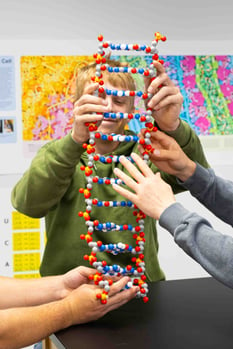
Because learners are constantly manipulating the model and articulating what they think, assessment stops being a separate event bolted onto the end.
Formative, in Wonder. Ask learners to notice specific components or characteristics of the model. What they see, and what they miss, tells you where to begin.
Formative, in Explore. Ask learners to manipulate the model to show a concept or use a term. Misconceptions appear in the arrangement, not just in the answer.
Summative, in Explain. Ask learners to evaluate or improve the model to meet a new constraint. That requires them to apply conceptual understanding rather than recall it, and it's difficult to fake.
The Cycle Repeats
WE² Model is iterative. Learners and educators move through the phases more than once in a single learning cycle, and the order is not fixed — a lesson might run through Wonder and Explore several times before reaching Explain. Wonder in particular is threaded throughout rather than confined to the opening.
That's by design. The goal of a WE² Model activity is not for learners to finish with answers. It's for them to finish with better questions — deeper, more specific, and often well beyond the scope of the original learning objective. Each pass through the cycle should raise the ceiling.
The Same Lesson, Three Ways
The Traditional Lesson
Students are told about oxygen and hydrogen, atomic composition, the unequal sharing of electrons that produces a polar covalent bond, how polar molecules attract each other through hydrogen bonds, and how those bonds produce cohesion and adhesion. This is the standard progression in biology textbooks. It's a demanding one, given that most U.S. students take biology with little or no chemistry background. They've been told about the core ideas without any authentic chance to engage with them.
Inquiry with a Traditional Model
Students examine a labeled image of a water molecule and identify the atoms and the charges. It's a genuine improvement over lecture. But it still requires prior learning: What is oxygen? What is hydrogen? Why are there charges on this figure? Students who clear that barrier can usually apply the vocabulary, redraw the figure, and answer questions about the properties of water — and it still isn't clear how well they understand it. Often the model they produce parrots the model they were shown.
WE² Model with a Foundational Model
Learners are handed magnetic 3D water molecules in CPK colors — red oxygen, white hydrogen — and given a few minutes to play. No prior knowledge required. They notice each molecule has one red piece and two white ones. They notice the white part of one molecule seems drawn to the red part of another. They notice white parts pushing each other away, and that each red part seems to want two partners. Within minutes, every learner in the room has experienced the behavior of water and started asking why.
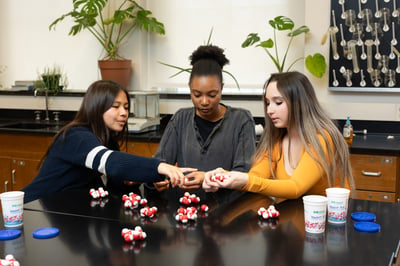
Then, just in time, the vocabulary arrives — and it has somewhere to land. Learners can answer the questions they generated themselves. As new wonderings come up, they test them with more pieces: What happens if we add sodium chloride? Why is water the universal solvent? What happens when a molecule with no charge meets water? If a question doesn't have a matching part, they build one.
Same content. Same standards. Different starting point.
What This Looks Like in Your Classroom
Wonder: Invite Curiosity
-
Put a foundational model in learners' hands and prompt noticing and wondering.
-
Keep this phase non-evaluative — no vocabulary quiz, no right answer yet.
-
Capture questions as a class and use them to inform the learning arc.
This early focus on wonder elevates student voice and creates a more equitable entry point, especially for learners who may be hesitant to share in traditional discussion formats.
Explore: Build Shared Understanding
- Guide conversation and activity toward key concepts and language, always anchored in the model.
- Encourage small-group work where learners manipulate the model, test ideas, and connect them to evidence or data.
- As the unit progresses, invite learners to pursue their own wonderings through targeted investigations or revised models.
Explore helps abstract ideas and vocabulary stick, because they are always tied back to the shared experience of the model.
Explain: Share and Revise Thinking
-
Ask learners to use the model — physical, drawn, digital, or conceptual — to explain a phenomenon or mechanism.
-
Look for misconceptions in how students build or describe the model, and address them in the moment.
-
Revisit earlier questions from the Wonder phase and invite learners to update their models based on new evidence.
Explain makes learner thinking visible and gives you a powerful formative assessment tool grounded in modeling.
What WE² Model Helps You Do
-
Engage learners by centering curiosity and hands-on interaction — the lesson opens with their questions, not yours.
-
Encourage critical thinking as students ask how and why about what the model shows, rather than what it's called.
-
Increase accessibility by giving every learner a shared, tangible entry point into complex content, with no prerequisite vocabulary.
-
Improve communication as learners use models to explain ideas to peers and teachers, with the model carrying part of the explanation.
-
Reveal misconceptions through how learners build, manipulate, and describe their models — visible in the arrangement, not just the answer.
Why This Matters Now
As information becomes easier to find, the need for critical thinking, scientific literacy, and genuine engagement has only grown. WE² Model responds to that shift by grounding learning in shared, embodied experiences with foundational models, supporting deeper reasoning, equitable participation, and meaningful connections between students' questions and core science ideas.
You can't Google your way through a physical demonstration.
Developed by Educators
WE² Model was developed by 3D Molecular Designs in collaboration with experienced modeling educators Chris Chou, Jim Lane, Keri Shingleton, and Dan Williams. The framework builds on the collective experience of educators who have participated in Modeling the Molecular World and other 3D Molecular Designs professional-learning programs.
Start Teaching This Way
Learn the Framework In Person
Summer courses where you practice WE² Model with the models themselves.
Try It with Free Materials
Teacher guides, slide decks, and activities built on foundational models.
Classroom Foundational Models
Kits and models for middle school through college.