





Why Modeling Matters
Modeling Isn't an Activity.
It's How Science Gets Understood.
For 25 years, we've built physical models that put molecular science in students' hands — because learners need to explore an idea before they can name it.
What Is Model-Based Learning?
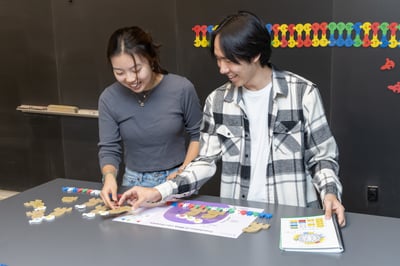
Model-based learning uses a physical or conceptual model as the starting point for instruction rather than the final product. Students handle a representation of a molecule or system, make observations, ask questions, and build explanations — connecting scientific vocabulary to something they have already experienced. Modeling is the process learners use to make sense of a concept, test a prediction, or communicate a complex idea.
.jpg?width=450&height=300&name=0D6A0228%20(1).jpg "0D6A0228 (1)")
Molecular Biology Asks Students to Picture What They Can't See
DNA replication, protein folding, membrane transport, enzyme specificity — the core content of modern biology happens at a scale no student will ever observe directly. Traditionally, we've asked learners to build their understanding of these processes from diagrams and definitions, which means the students who succeed are often those who already have the vocabulary and spatial reasoning to translate a flat picture into a three-dimensional idea.
Meanwhile, information has never been easier to find. Facts once accessible to a few are a search away. What's scarce now is the ability to reason, to evaluate, and to explain. Educators feel this: they're asking how to build critical thinking when answers are free.
You can't Google your way through a physical demonstration.
Four Things Change When Models Come First
Concepts Before Vocabulary
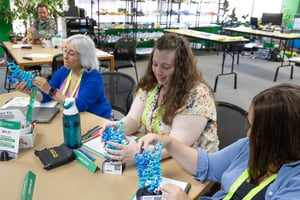
When learners explore a model with their hands, abstract ideas become something they can question, discuss, and revise. Vocabulary sticks when it's attached to a real experience. Students build the meaning first, and the word becomes a label for something they already understand.
Research on science learning for multilingual students supports this sequence directly: doing science inherently involves language, which "differs greatly from the conventional perspective that focuses on learning vocabulary and grammar before they use it" (Lee, Quinn & Valdés, 2013).
Curiosity and Conversation
Models invite learners into science through observation and play. As students handle a model, they naturally start asking questions about structure, function, and change — and those questions turn into conversation as classmates compare interpretations and refine explanations together.
Because the conversation centers on a shared object, students don't need prior knowledge to participate. The model becomes the common language.
Access for Every Learner
A tangible starting point lowers the barrier to entry regardless of prior knowledge, language, or confidence. Models can be largely language-independent, which makes them a recommended practice for English learners (Fairbairn & Jones-Vo, 2010). For students who are blind or have low vision, tactile representations are not a supplement but the primary route into abstract concepts (Sahin & Yorek, 2009).
In a three-year study of an undergraduate cell and molecular biology course, students made significantly higher gains on the concepts taught with physical models than on concepts taught through clicker questions or peer discussion, measured with a validated Central Dogma Concept Inventory. Higher-performing students refined mental models they already had; lower-performing students built new understanding much closer to an expert's (Newman et al., 2018).
Thinking Made Visible
Many students can redraw a mitosis diagram and still hold misconceptions about chromosome structure. Hand them a model and ask them to show replication, and the confusion surfaces immediately — sister chromatids, homologous pairs, replicated versus unreplicated chromosomes. The teacher can see the misconception in the model's arrangement and ask a guiding question in the moment.
That makes modeling simultaneously an instructional tool and an assessment tool.
What the Research Says About Modeling
Modeling isn't our idea. It's a scientific practice, and the case for teaching it is documented.
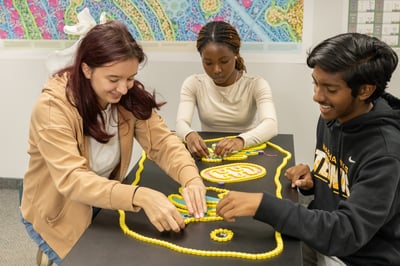
It's a national standard. "Developing and Using Models" is Practice 2 of the eight science and engineering practices in the NRC's Framework for K-12 Science Education and the NGSS. The standard explicitly names our category: students should "represent and explain phenomena with multiple types of models — for example, represent molecules with 3-D models or with bond diagrams." Some researchers argue that modeling is the practice that anchors the other seven (Schwarz, Passmore & Reiser, 2017). At the undergraduate level, Vision and Change names modeling and simulation as one of four core competencies.
Handling a model changes outcomes measurably. In a 2025 study, letting students handle physical macromolecule models for just three to five minutes converted low-gain lectures into medium-gain lectures on protein and DNA misconceptions (Biochemistry and Molecular Biology Education).
It can narrow gaps. A single exposure to handheld physical protein models raised students' quiz scores from 9.1 (without models) to 12.1 (with models) out of 27 (Forbes-Lorman et al., 2016). For females, physical models significantly increased quiz scores by about 5 points (p=0.001). In the group without physical models, males scored approximately 2.5 higher than females.
Active engagement beats lecture at scale. Across 6,542 introductory physics students, courses using interactive engagement achieved conceptual learning gains roughly double those of traditional courses (Hake, 1998).
Physical manipulation supports cognition. Embodied cognition research finds that sensory and motor engagement shapes understanding — when learners manipulate a model, touch and proprioception become part of how they reason (Newcombe & Weisberg, 2017; DeSutter & Stieff, 2017).
Where the Evidence is Still Open
Several rigorous studies find that well-designed virtual models produce learning gains statistically equivalent to physical ones (Stull & Hegarty, 2016). The strongest claim the research supports is not that physical models beat digital ones — it's that models beat no models, and that physical and digital work best together. That's why we build augmented reality and interactive activities alongside our kits rather than instead of them.
There are also real gaps. Most modeling research has studied undergraduates, not high school students. Most of it comes from chemistry and earth science rather than biology. And touch remains far less studied than vision or hearing. Those gaps are part of why we do funded research rather than only selling products.
How Modeling Maps to Your Standards
| Framework | Where Modeling Appears |
| NGSS / NRC Framework | Science & Engineering Practice 2, "Developing and Using Models" — grades 9–12 expect students to develop, revise, and use models, and to move flexibly between model types |
| AP Biology | Science Practice 2, "Visual Representations" — 16–24% of the multiple-choice exam |
| IB Biology | Nature of Science: modeling to illustrate, explain, and predict phenomena |
| Vision and Change (undergraduate) | Modeling and simulation named one of four core competencies |
Modeling is pervasive in the standards. It's also where many educators report feeling least prepared — often because modeling was treated as a final product in their own training rather than as a tool for sensemaking (Chiu & Lin, 2019; Crawford, 2019). Our programs exist to close that gap.
How We Put this into Practice: WE² Model
Two ideas shape everything we make.
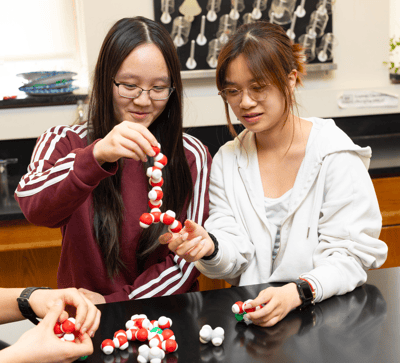
The first is the foundational model: an interactive, usually tactile model with a low threshold and a high ceiling, designed so students can use it throughout a learning cycle for many different objectives. Not a diagram of a finished idea — a gateway into one. Because every student enters from the same place of play and observation, prior knowledge is no longer the price of admission.
The second is WE² Model (Wonder, Explore, Explain), our framework for building lessons around foundational models. Wonder starts with what students notice and ask, non-evaluative and grounded in the shared model. Explore connects those observations to core ideas and vocabulary. Explain brings student thinking into the open, where it can be shared, challenged, and revised. The cycle is iterative, not linear — and unlike frameworks that place modeling at the end, here the model stays at the center of every phase.
25 years of model-based science education · 15 NIH and NSF research awards · 1,000,000+ learners using our models each year
Why We Care About This
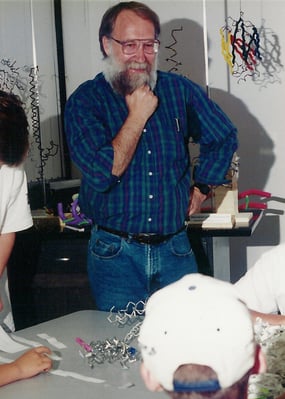
In the mid-1990s, Tim Herman was a biochemistry faculty member at the Medical College of Wisconsin bending protein backbone models out of steel wire with a device called Byron's Bender — for his own research, and for colleagues'. After seeing a 3D-printed protein at a conference, he worked with the rapid prototyping center at the Milwaukee School of Engineering to build a large green fluorescent protein model, opened the Center for BioMolecular Modeling there in 1998, and founded 3D Molecular Designs out of his basement in 1999.
Then teachers saw the models and wanted classroom sets.
That turn — from research tool to teaching tool — is the whole company. Over 25 years we've been awarded 15 SEPA and SBIR grants from the National Institutes of Health and the National Science Foundation to study how models improve science learning, on topics from CRISPR and sickle cell anemia to pandemic preparedness and the molecular mechanisms of addiction.
The Center for BioMolecular Modeling merged into 3DMD in 2022. We're still in Milwaukee, still family-run, and still testing our materials in real classrooms before we sell them.
"My students love using 3D Molecular Designs' physical models with AR overlay. It's a really cool way for them to learn and is much better than physical or digital alone."
— A. Belcher, AP Biology Teacher
"The professional development experiences I have had through 3D Molecular Designs have completely changed my perception of the natural world. Each workshop fosters community, inquiry, and a deep understanding of the molecular basis of life."
— Summer Course Participant
Common Questions About Teaching With Models
Do physical models still matter now that simulations and AI visualizations exist?
Yes, and the honest answer is that they work best together. Studies comparing well-designed virtual models to physical ones often find equivalent learning gains. What physical models add is shared, embodied, low-barrier access — several students around one object, no device required, no login. That's why our kits ship with free digital and augmented reality extensions rather than competing with them.
Isn't modeling something students do at the end of a unit?
That's the traditional use, and it's the shift we're arguing for. When a model is only a final product, it can't help students make sense of anything along the way. Researchers describe this as the difference between using "models of" science and using "models for" learning (Gouvea & Passmore, 2017).
I don't have time to add an activity. Where would this fit?
It doesn't have to be an activity. In one study, three to five minutes of students handling a physical model during an otherwise ordinary lecture measurably improved conceptual gains. Start there.
Do I need training to teach this way?
No, but most teachers tell us it helps — especially if modeling wasn't part of their own preparation. Our summer courses, Model Teacher Program, and free resources all exist for that reason.
What if I want to try before we buy?
Our Lending Library lets you borrow classroom kits for a week and use them with your students first.
Start Anywhere
Learn to teach with models
Summer courses, teacher leadership, and student programs.
Try it for Free
Teacher guides, AR experiences, and interactive activities.
Put models in students' hands
Kits and models for middle school through college.