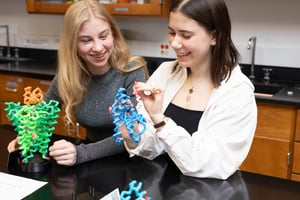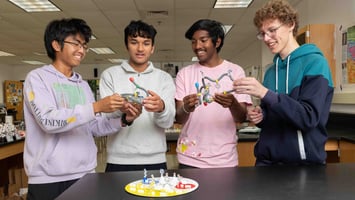




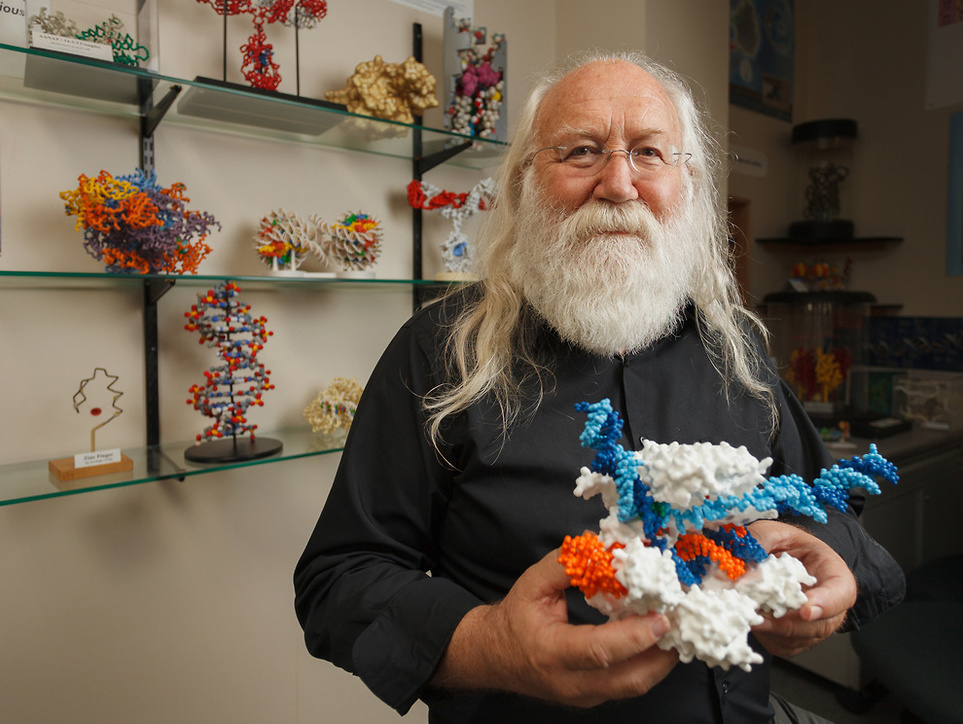
Here in Wisconsin, we always look forward to the fall… and the changing seasons.
Here in Wisconsin, we always look forward to the fall… and the changing seasons. There is nothing like a few 150 mornings to clear your sinuses and get the blood pumping. Unfortunately, some of our colleagues are not fortunate enough to live in Wisconsin and, therefore, cannot experience this time-marking event. But there is another annual event that everyone (especially science educators) can use to mark each passing year, regardless of where you live. And that is the Nobel Prize season. Every fall – during the first week of October – the Nobel Prize Committee in Sweden announces a new series of Nobel Prizes.
 Of course – as we have mentioned many times – there is no Nobel Prize in Biology. I guess back in 1940, when Alfred Nobel founded the Nobel Prizes, biology was not considered a serious science. It seemed as though most biologists were just collecting butterflies and trying to name and catalog all the strange new plants and animals they were discovering in their rapidly expanding world. We can forgive Alfred this oversight because back in the early 1900’s molecular biology had not yet been invented.
But no matter…. with time, as the Nobel Committee realized like others that “it is in biology that chemistry and physics come alive”, they began awarding the Nobel Prize in Chemistry and the Nobel Prize in Physiology or Medicine to people whose work had made a significant contribution to the field of Biology. Even the Physics prize has been occasionally awarded to people whose work has opened new approaches to exploring the invisible molecular world of proteins, viruses and cells.
Checking in on your science…
The Nobel Prize is awarded to people – researchers whose recent work has been judged by the selection committee to have advanced a field of science. This is great fun because (i) these winners are usually very interesting people whose backstories are of interest to young people who hope to one day win their own Nobel Prize, and (ii) because each award inevitably stirs up a controversy in the scientific community regarding the several other researchers in the field who were not included in the award. But for 3DMD and our educator colleagues, the real value of a Nobel Prize is not to identify a person, but rather to shine a light on a notable development in a particular field of science. As educators, we are not intimately involved in the cutting-edge research that is going to win a Nobel Prize. Instead, we are busy teaching our students yesterday’s science – the very science that was celebrated by previous Nobel Prizes over the past 124 years. So, for us, the annual Nobel Prize awards provide a way for us to check in with the research community to learn about new developments in our field. And then we can start thinking about how we can introduce our students to this new science in next year’s course.
If you share our view of the real purpose of the annual Nobel Prize announcements, then you must have been as excited as we were with the 2024 Nobel Prizes. All three major prizes – in Chemistry, in Physics and in Physiology or Medicine – highlighted a major advance in our understanding of the molecular biosciences.
The 2024 Nobel Prize in Chemistry
-1.jpg?width=194&height=219&name=OIP%20(1)-1.jpg) The 2024 Nobel Prize in Chemistry was probably our favorite 2024 Prize because David Baker was one of three people who shared this Prize. We have been following David’s work in de novo protein design for many years – going all the way back to Fold-It (https://fold.it) and the design of one of his first designed proteins, Top7, way back in 20031. We have been predicting that David would win a Nobel Prize for the past several years – so we were happy to see that the selection committee finally got it right in 2024.
The 2024 Nobel Prize in Chemistry was probably our favorite 2024 Prize because David Baker was one of three people who shared this Prize. We have been following David’s work in de novo protein design for many years – going all the way back to Fold-It (https://fold.it) and the design of one of his first designed proteins, Top7, way back in 20031. We have been predicting that David would win a Nobel Prize for the past several years – so we were happy to see that the selection committee finally got it right in 2024. 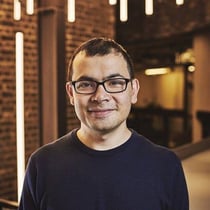
David shared this year’s Chemistry Prize with two other people (Demis Hassabis and John Jumper) from Google DeepMind who developed AlphaFold – an AI model that effectively solved one of the grand challenges in biology – the Protein Folding Problem. In the 2022 CASP competition – a biennial competition to predict 3D protein structures from an amino acid sequence – AlphaFold achieved a greater than 90% accuracy rating for its predictions of several proteins used in the competition.
AlphaFold was trained on a dataset comprised of the amino acid sequences of 130,000 proteins whose 3D structures had been experimentally solved and whose atomic coordinates were deposited in the Protein Data Bank. Within a few days of AlphaFold being released to the scientific community in 2022 the number of protein structures in the Protein Data Bank increased … overnight… from 170,000 to 1,200,000 – including virtually all proteins encoded by the human genome. Is this a great county -- or what?
If you have 22 minutes to spare, you should watch an outstanding video produced by Quanta magazine entitled How AI Cracked the Protein Folding Code and Won a Nobel Prize. This video tells the story of the Protein Folding Problem, the CASP competition, AlphaFold, and Protein Design. Your time will be well spent.
The 2024 Nobel Prize in Physics
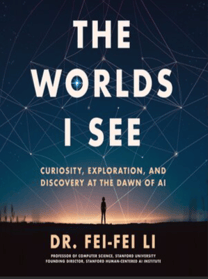 We also were very pleased with the 2024 Physics Prize because it highlighted two computer scientists (Geoffrey Hinton and John Hopfield) whose work in artificial Intelligence laid the foundation for the kind of artificial neural network used by AlphaFold to solve the Protein Folding Problem. So foundational work in AI resulted in an application (AlphaFold) that solved a long-standing problem in biology. And if you are like me – and not quite sure what AI is and where it has come from – then I can recommend a book that provides an interesting introduction to this story. Check out The Worlds I See by Fei Fei Li. It is a great read.
The 2024 Nobel Prize in Physiology or Medicine .jpg?width=288&height=244&name=OIP%20(3).jpg)
Remember those lists that we have always encouraged you to make while you attend a 3DMD summer course? You know…. Things I Know – Things I Know I Don’t Know – Things I Don’t Even Know I Don’t Know. The most important list is of Things I Know I Don’t Know.
The 2024 Nobel Prize in Physiology or Medicine highlights a topic that has been on my list of things I didn’t understand for some time now. The prize honors Victor Ambros and Gary Ruvkun for their work on micro RNA (miRNA) and its role in regulating gene expression. I have been hearing about multiple families of small RNAs for many years, but the story about what they were doing and how they were doing it, was always very messy and confusing. So, I was content to not pay much attention until those nerdy researchers finally figured out what was going on. I guess the 2024 Physiology or Medicine Prize marks a milestone in the development of that messy story. We can now say with some assurance that the expression of thousands of human protein-encoding genes are regulated by thousands of miRNAs that bind specifically to mRNAs and regulate the amount of protein that is translated from that mRNA2. How many of us are teaching this newly recognized mechanism of gene regulation? Now, you can start worrying about how you will find time in your over-crowded curriculum to add this exciting new mechanism of gene regulation.
I am tempted to write more about how miRNA works. But that would take several more pages of text and probably more knowledge about the subject than I currently have. So… watch our website for more information about a webinar coming your way in 2025 in which we will explore this new topic in more detail…with models.
One final thought… about our Summer Courses.
Are you wondering about:
Who/What might win a Nobel Prize next year?
... or
How can you involve your students in anticipating each Nobel Prize season?
To answer both questions, make plans right away to attend a 3DMD summer course in the summer of 2025. We will tell stories about 3DMD’s many interactions with Nobel laureates over the years. We are most proud of the fact that our interactions with these people have almost always happened before their Nobel Prizes were awarded. We like to think that this simply indicates our “good taste”. So, if you are wondering who/what will be awarded a Nobel Prize soon, just come to a summer course and find out what we are working on now. (Hint: we are beginning to highlight this work in our Modeling Infection and Immunity workshop).
Other interesting references….
Here is a link to the paper describing the de novo designed Top7 protein…
Design of a Novel Globular Protein Fold with Atomic Level Accuracy.
G Dantas, GC Ireton, G Varani, BL Stoddard, D Baker - science, 2003 - science.org
Design_of_a_Novel_Globular_Protein_Fold_with_Atomic-Level_Accuracy-libre.pdf
Here is a link to a review of miRNA…
This is a longish/detailed review. But the abstract and the intro are very good…..
MicroRNAs: From Mechanism to Organism.
Dexheimer and L Cochella , Frontiers in Cell and Dev. Biol. June 2020