




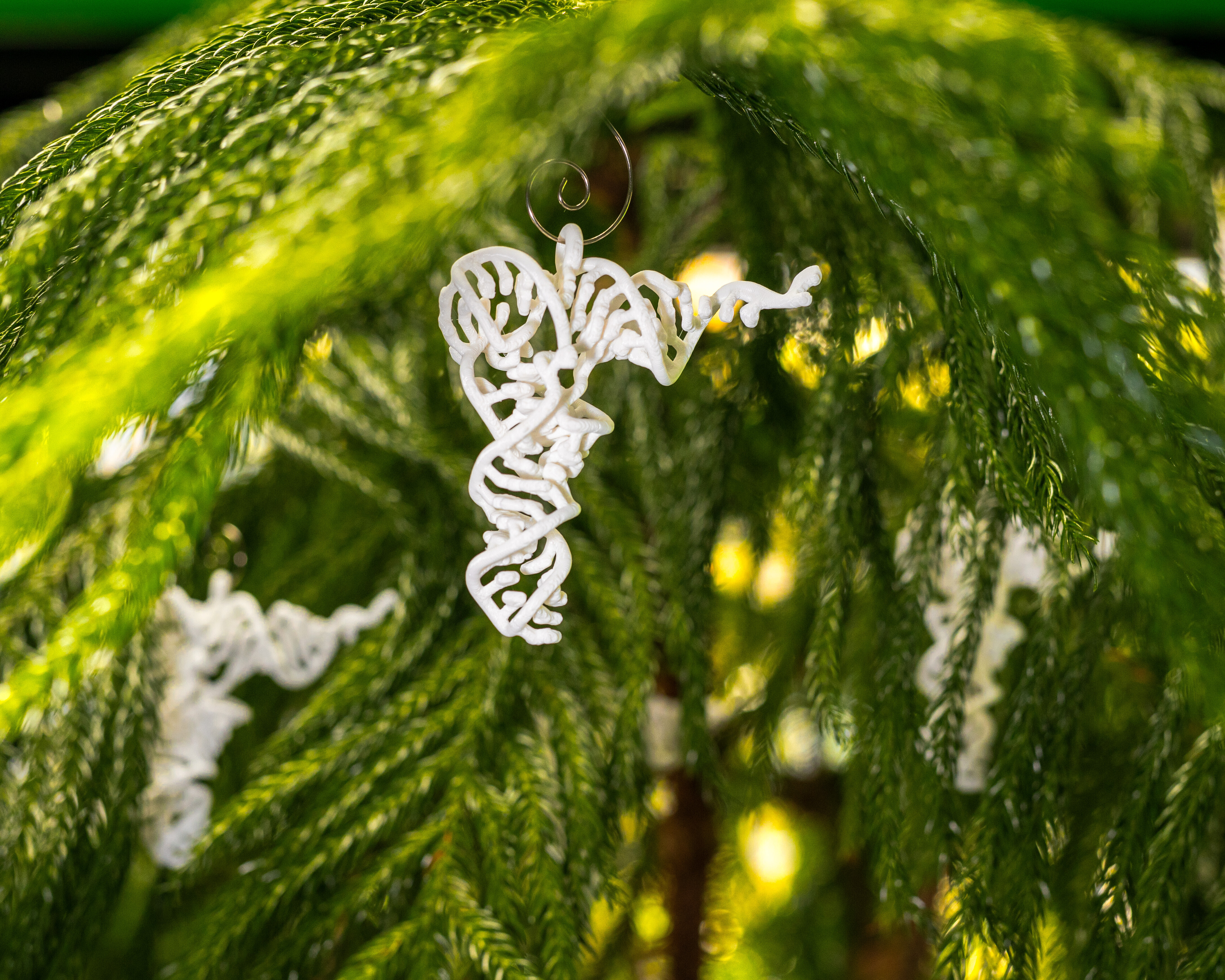
Transfer RNA (tRNA) is not only an elegant molecule but also a fascinating structure-function story. The relationship between structure and function is fundamental in all living things and is a cross-cutting concept in the sciences.
tRNA helps our bodies make proteins in conjunction with messenger RNA (mRNA) and large molecules called ribosomes by delivering amino acids to ribosomes, where they are joined together to make proteins. Each tRNA delivers only one type of amino acid. As a result, each has a few nucleotides that differ from other tRNAs.
Structure
To deliver amino acids, tRNA has developed an L-shaped structure over evolutionary time, which enables it to interact with ribosomes at a precise location. The 72-nucleotide tRNA folds into its L shape, forming base pairs like DNA – except RNA has uracil instead of thymine. The adenine-uracil (A-U) and guanine-cytosine (G-C) bonding stabilize the structure. Each tRNA has two distinct sites, as noted in the photo below. tRNA's actual structure is quite different from the linear one we commonly think of as RNA or see in textbooks or online which traditionally show tRNA as a clover-leaf structure.
Caption: This accurate image of a tRNA model shows the anticodon
and CCA sites, and complementary base pairs.
- The sugar-phosphate backbone of the nucleotides is shown as a solid strand.
- Note the detail of the CCA nucleotide shapes in the top magnified white circle. Every tRNA has the same CCA sequence (cytosine, cytosine, adenine) at this 3’ end.
- The bottom magnified white circle shows the detail of three nucleotides that form the anticodon. These nucleotides vary in tRNAs, depending on the specific mRNA sequence being translated, and determine which amino acid is attached to the CCA 3’ end.
- The shapes of the nucleotides and complementary base pairing are visible.
Function
The process that makes protein synthesis possible begins in the nucleus, where the DNA code for each protein is transcribed into messenger RNA (mRNA). The mRNA then leaves the nucleus and moves to ribosomes in the cell's cytoplasm. The code for each amino acid needed to form a specific protein is contained in three-nucleotide units called codons. This is referred to as the triplet code.
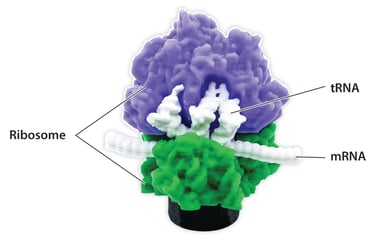 Ribosomes translate the mRNA into protein. The correct tRNA bonds to the mRNA codon in the ribosome by matching up the tRNA's anticodons to the mRNA's triplet codons. In this way, the amino acids are joined in a specific sequence dictated by the mRNA codons. TRNA is sometimes called the adaptor molecule because it translates the codons in mRNA.
Caption: This image of a ribosome with three tRNA
delivering amino acids based on the mRNA codon sequence.
For more information how to translate, transcribe, and replicate DNA see 3D Molecular Designs’ Flow of Genetic Information Kit©! It’s a dynamic puzzle!