





Jim Lane teaches high school biology, including a field ecology class where students go into the woods once a week to listen to birds. One year, his students kept noticing a small bird they couldn't name, so they called it the "DD bird," after its call. They kept watching it. They learned where it nested, what it ate, and how it behaved. Only after they knew all that did Jim tell them its name: black-capped chickadee. "If I had just said that's a black-capped chickadee, that would have been it," he told teachers at our Modeling the Molecular World course this summer. "They wouldn't have looked at the other things." In Explore, the name comes after the noticing.
When should science vocabulary arrive? In the Explore phase of WE² Model, it arrives just in time, after students have experienced an idea with the model and need a word to talk about it. The teacher's role is light: few directions, small redirects, and a new challenge for the model at the right moment.
Why the Idea Comes First
Bryan Brown and Kihyun Ryoo (2008) tested this timing directly. They randomly assigned 49 fifth graders to two versions of the same computer lesson on photosynthesis. One version taught the ideas in everyday language first, using phrases like "energy pouch" and "sugar," and introduced "chloroplast" and "glucose" afterward. The other version used the scientific terms from the start. On the posttest, the content-first group scored higher, 29.4 points to 19.3, including on questions asked in scientific language.
The study had limits. It took place in one classroom, with no teacher and no models, and students were tested right after the lesson, so it doesn't show how long the learning lasted. A later study by Ryoo with 220 fifth graders found the same pattern. Students who met the idea first learned the word better too.
Name It When Students Need It
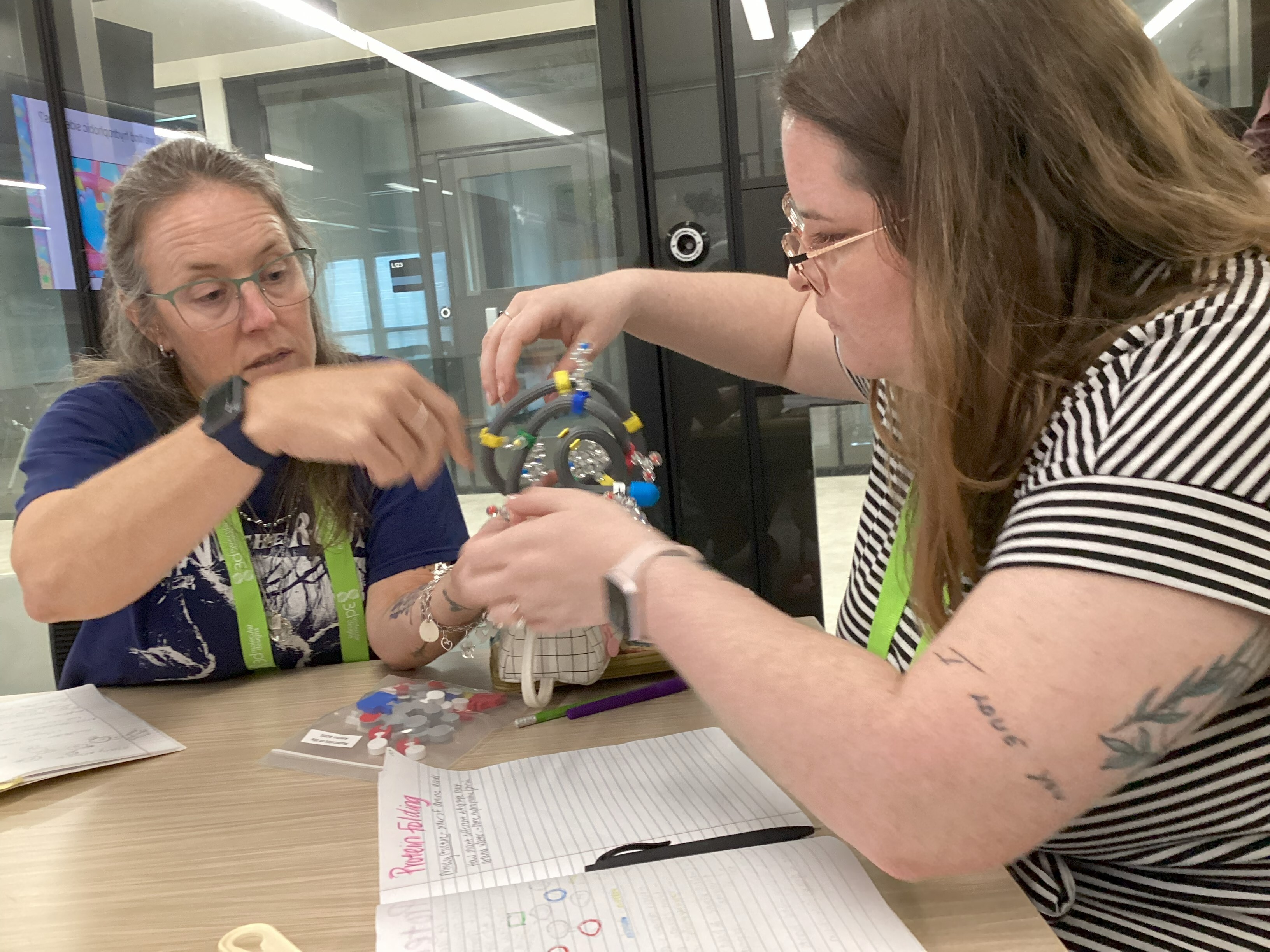
In Milwaukee, teachers had just finished the first Amino Acid Starter Kit© activity, discovering the properties of the side chains and folding a random sequence into a stable shape. Ron Call, a high school biology teacher from Idaho, said his table agreed that "it really is not necessary at all to know the names of amino acids" for that work.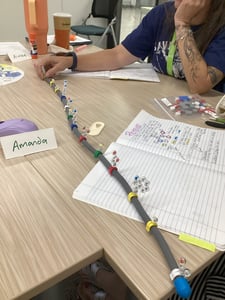 Students "get hung up on all these complicated names," he said. "When vocabulary becomes useful to them, then they'll remember it."
Tim Herman likes to point out that the same students who resist 20 amino acids can name 50 different Pokémon. As I said to the group, they had a reason to learn. Leah Inman finished the thought: "It's about what you care about." Her students can name a hundred birds and a hundred Pokémon, "but not 20 amino acids."
The pedagogy is to hold the term until students have experienced the idea and need a word to share it. Jim put it simply: "That vocabulary wasn't important until we communicated it to somebody else." Until then, the class's own names do the job. Everyone in Jim's class knew exactly which bird the "DD bird" was.
Few Directions, Small Redirects
Brianna Caljean, the teacher who warned in our last post that students "will do exactly what you tell them to do and then stop," described what her table noticed about the activity: "There were few directions, but there were very small redirects as needed."
She added that the two parts work together: "It's the combo that's important, like giving very minimal instructions and making sure you are visiting each table." Short instructions leave room to explore, and the table visits keep each group headed toward the core idea.
Shake It: Find the Limits of the Explanation
Once every table had a stable folded protein, we gave them a new challenge: shake your model. The shaking simulates a protein moving around in the cell. As teachers shook, their proteins lost their shape.
Ron's table admitted their first reaction: "What's the point of shaking it?" Then they realized what the shaking showed. A fold held together only by side chain properties couldn't keep its shape, so the protein needed something more. That created the need for alpha helices and beta sheets, and the vocabulary arrived just in time, with a reason attached.
Even teachers who knew the content found new connections. "I haven't thought of it that way," Leah said. Another teacher noticed what happened as the folded structure took shape: "The model really became predictive."
What It Looks Like in Your Classroom
- Middle school. With the Water Kit©, let students describe "the red part" and "the white parts"
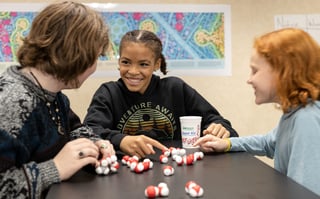 in their own words. Introduce "partial charge" and "hydrogen bond" once they need words to explain why the molecules stick together.
- High school and college. With the Amino Acid Starter Kit©, map the vocabulary to the moment students need it. Students sort the side chains by colored clip, and then "hydrophobic," "hydrophilic," "acidic," and "basic" arrive. They fold a sequence by following those properties, and then "tertiary structure" arrives. They shake the model, and then "alpha helix" and "beta sheet" arrive. Side chain names can wait; "the yellow ones" works until a name is useful.
Try This Week
At the end of our Explore discussion, I asked the group two questions that apply in any classroom: "How do these models and our conversations help us think differently about these questions? And how do these questions help guide our learning?"
This week, pick one term you usually introduce at the start of a lesson and hold it until students need it. Adjust the timing for your students. Which words do your students learn better once they've needed them? Reply and tell us.
→Next in the series: Explore, when students use the model to show what they think.
Resources for This Lesson
- How to Start a Lesson With Wonder
- WE² Model: Wonder, Explore, Explain
- Amino Acid Starter Kit©
- Water Kit©
- Summer Courses
- Brown, B. A., & Ryoo, K. (2008). Teaching science as a language: A "content-first" approach to science teaching. Journal of Research in Science Teaching, 45(5), 529–553.
Get the next classroom idea each Tuesday.