





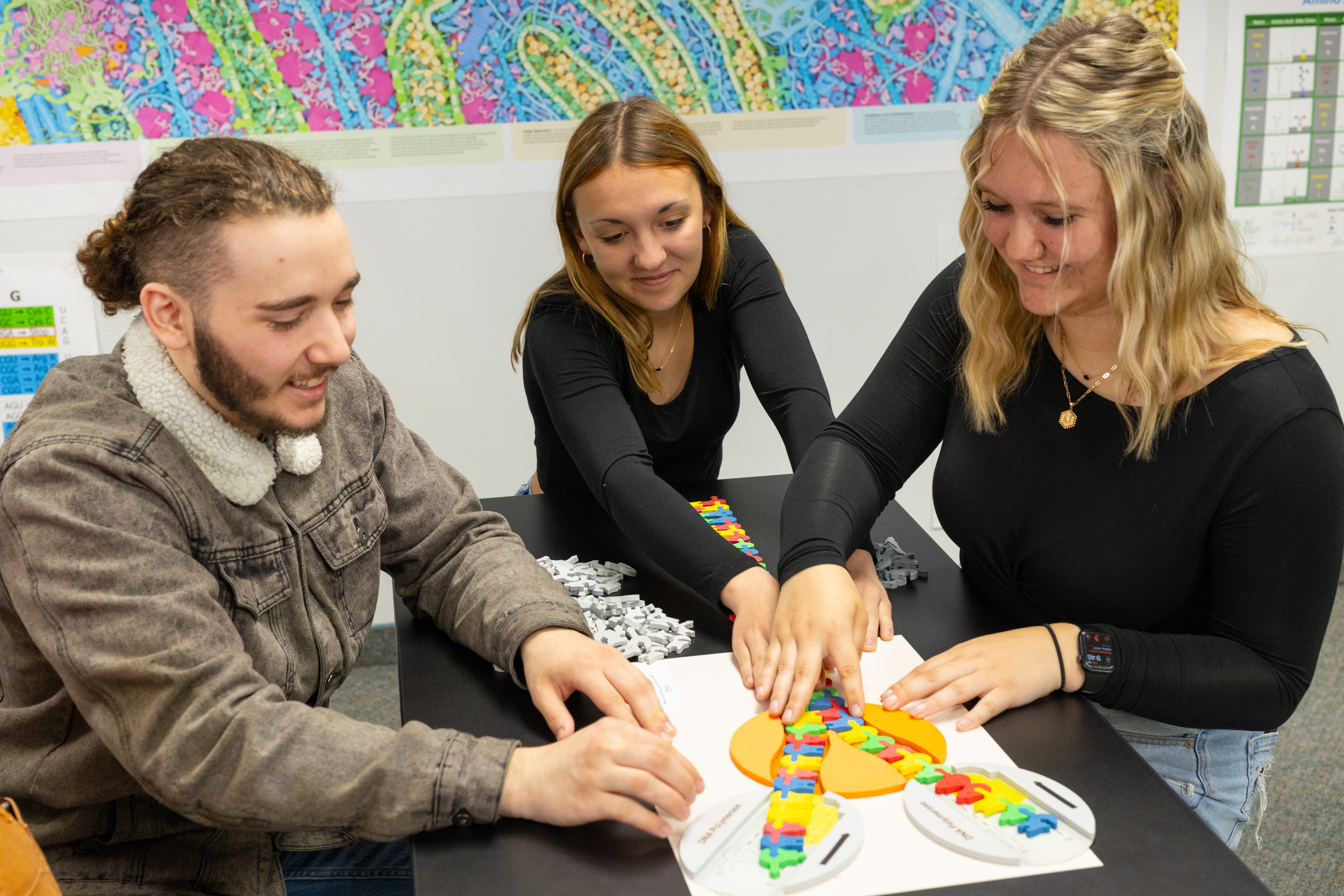
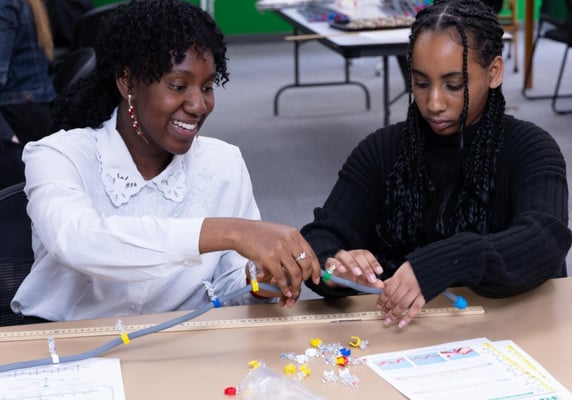
When students work with physical, 3D models of molecules and cells, they don’t just “have fun”—they tend to learn more deeply, participate more equitably, and engage in the kind of sensemaking real scientists do. The research around model-based biology teaching is clear enough that it’s worth asking: what small shifts could you make this year to put more models in students’ hands in intentional ways?
When "Knowing the Facts" Isn't Enough
Picture a familiar scene: you’re explaining the Central Dogma again. Students can chant “DNA → RNA → protein,” and they’ve filled out the graphic organizer, but when you ask them to explain how a mutation might change a protein—or to sketch what’s happening—many of their answers reveal shaky mental models. It’s not that they haven’t seen the slides or heard the story; they just can’t quite see it well enough to reason with it.
One teacher who attended a recent modeling workshop summed up the difference this way: “The sequence of modeling kits leading from properties of water to protein folding was a great way to develop student understanding of complex concepts and structures.” In other words, the facts started to click once students could literally pick them up, turn them around, and test ideas with their hands.
That’s the promise of model-based instruction in biology—and it’s increasingly backed by research.
Finding 1: Physical Models Drive Deeper Learning
Teaching question: Do hands-on models really do more for student learning than a polished slide deck, simulation, or clicker questions?
A growing body of research says yes—especially for complex, invisible biology.
One study by Newman and colleagues compared sections of a course where students learned the Central Dogma through physical model-based activities to sections that used active, but non-model approaches, such as clicker questions and peer discussion. Students in the model-based sections showed significantly higher learning gains, and the lowest-performing students made the largest absolute gains, suggesting that models helped more students cross the threshold into solid understanding.
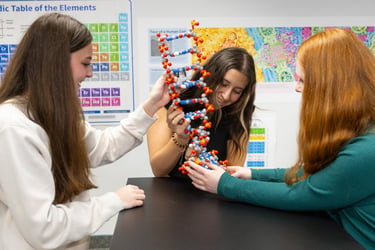 Other studies in molecular biology and related fields echo this pattern. Roberts and colleagues found that physical models enhanced students’ three-dimensional molecular literacy, helping them reason about protein and DNA structure in ways that diagrams alone did not. Davenport and coauthors showed that a self-assisting protein folding model improved students’ spatial awareness and understanding of structure–function relationships. Work by Forbes-Lorman and others indicates that physical models can support a nuanced understanding of protein structure–function, sometimes in gender-specific ways, and Tepla and coauthors reported that 3D models and animations positively influenced student learning across natural science subjects.
From a cognitive perspective, these models seem to help students organize complex information into coherent mental schematics, thereby lowering cognitive load and allowing new ideas to stick. Students themselves often report that, while the model doesn’t magically “explain it better,” it helps them remember and reconstruct processes independently later.
One teacher described the shift this way: “All of the varied models helped me think about how cellular structures function together. I learned how to use models more effectively and different ways to scaffold them into my curriculum.”
A Move To Try: Trade one Review Lecture for a Model Explanation Day
If you only have time for one change this term, consider this:
- Identify a process students routinely struggle with—transcription and translation, membrane transport, meiosis, or protein folding.
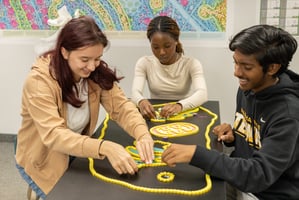
.jpg?width=375&height=250&name=0D6A0421%20(1).jpg) Instead of a slide-heavy review, give small groups a physical model of the relevant structures.
Instead of a slide-heavy review, give small groups a physical model of the relevant structures. - Ask students to use the model to explain the process to a partner, step by step, as if they’re recording an audio guide. Their partner should be able to sketch what they describe.
- Circulate and listen for where students hesitate or misplace pieces; those moments reveal the most important content to revisit.
- Start a new topic with models first. Let students handle a DNA, membrane, or chromosome model and answer, “What do you notice? What patterns do you see?”
- Only then layer in vocabulary and diagrams, tying each term to something they’ve already noticed and manipulated.
You might also experiment with flipping your usual order:
These are small structural changes, but they align your classroom more closely with what the research suggests about how students actually build durable understanding with models.
Finding 2: Models Make Biology More Equitable and Accessible
Teaching question: How can I lower the barrier so more students—not just the “diagram kids”—can participate in molecular biology?
The same Newman study that found overall gains with physical models also offers an encouraging equity signal: lower-performing students made the biggest absolute gains when they worked with models. There is also evidence that models may help address gender disparities in spatially demanding content by giving students tangible supports for building their mental models.
Beyond test scores, modeling shows up in the equity literature as a high-leverage practice. Schwarz and colleagues describe modeling as a way to make scientific reasoning visible and shared, which can be especially powerful when students enter with different levels of prior knowledge. Fairbairn and Jones-Vo identify modeling as a recommended strategy for multilingual learners, because it allows them to participate in scientific talk without needing all the vocabulary up front.
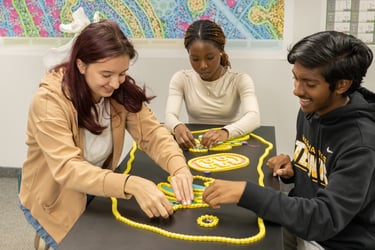 For students who are blind or low-vision, tactile models are even more crucial. Sahin and Yorek note that traditional science instruction, which leans heavily on visual representations, can leave these students without concrete experiences to anchor abstract concepts. Stone and Brown argue that while alt text helps, tactile representations and models are often the best way for visually impaired learners to grasp complex scientific ideas.
Taken together, this research aligns strongly with principles of Universal Design for Learning: when you represent core ideas in tactile and spatial ways, you give more learners more ways to understand and express those ideas.
One teacher reflected on this broader impact after a WE2-focused workshop: “I was affirmed as a practitioner and a learner throughout the day because this team treats our work as a craft and learning as brain-forward discovery… this manner of facilitation makes modeling a memorable and accessible way of thinking and admiring the world.”
A Move To Try: Start with Model Talk, then Add Terminology
You can leverage the equity of models without rewriting a unit.
- In small groups, give students a model connected to your current topic.
- Ask them to describe what they see and do using their own words, gestures, and languages: “This part looks like…,” “When I move this, that changes…,” “I think this might be where X happens.”
- As ideas surface, introduce formal terms that “name” what they already understand (e.g., “What you’re calling ‘the twisty ladder’ is the DNA double helix.”).
This approach centers shared observation and interaction with the model, rather than prior comfort with academic vocabulary. It allows multilingual learners, students with weaker background knowledge, and students who process information differently to contribute on equal footing.
Another simple move is to treat the model as a shared “third object” in tough conversations:
- When students debate a claim—such as “How can one base change cause sickle cell disease?”—ask them to show their reasoning on the model as they talk.
- Their gestures and manipulations become part of their explanation, and the model anchors the conversation in something everyone can see and touch.
These small shifts help modeling function as an equity tool, not just an enrichment activity for students who are already thriving.
Finding 3: Modeling is Most Powerful When Students Use Models to Do Science
Teaching question: Am I using models mainly as props to display information—or as tools that help students explain, predict, and test ideas?
Research on modeling in science education draws an important distinction between “models of” and “models for.” Gouvea and Passmore argue that we can think of models as representations of phenomena, and as tools for doing science—explaining, predicting, and guiding investigation. Schwarz and colleagues, along with Upmeier zu Belzen and others, describe modeling as a central scientific practice in which scientists iteratively construct, test, and revise representations to make sense of the world.
In classrooms, Malone and Schuchardt report that modeling-based pedagogy improves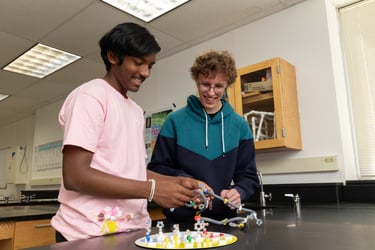 both scientific reasoning and content understanding across disciplines. Yet many teachers report confusion about what “modeling” really means in day-to-day instruction and note that they had little exposure to model-based pedagogy in their own preparation.
A key theme across this research is that models are most powerful when they’re woven into cycles of wondering, exploring, and explaining—not just handed out as end-of-unit summaries. This pattern sits at the heart of the WE2 Model (say WE Model) pedagogy we are developing with educators.
A Move To Try: A Simple Wonder-Explore-Explain Cycle
You can bring a more “models for” stance into your existing units with a simple three-step routine:
- Wonder with the model.
- Place a foundational model—water molecules, a phospholipid membrane, chromosomes, a synapse—on every table.
- Prompt students: “What do you notice? What do you wonder?” Encourage them to handle the model, look from different angles, and jot down individual and group questions.
- Capture their questions on the board or in a shared document without evaluating them.
- Explore with the model.
- Choose one or two student questions, or pose an essential question like “How does a mutation here change the protein?” or “Why do cells swell in hypotonic solution?”
- Ask students to manipulate the model to test or refine ideas: “If this changes, what happens to that?”
- Layer in targeted content and vocabulary just in time, connecting terms to specific parts and motions of the model.
- Explain with the model.
- Have students use the model to explain a phenomenon to a partner or in a short whiteboard or paper presentation: “Show me, with the model, how this antibiotic affects the bacterial cell,” for example.
- Their explanations serve as formative assessment and often reveal where their mental models differ from the scientific one.
- Invite them to revise both their physical configurations and their drawn or written explanations based on feedback.
Many teachers already use pieces of this pattern intuitively. The WE2 Model framework is about making that pedagogy visible and intentional: building repeatable Wonder–Explore–Explain cycles around foundational 3D models so students learn to use models the way scientists do.
Where To Start With Research-Based Modeling
It’s one thing to nod along with the research; it’s another to fit new practices into an already packed year. The good news is that you don’t need to redesign an entire course to benefit from model-based instruction.
You might start by identifying one unit where students consistently struggle to “see” what’s happening—Central Dogma, cell communication, immunity, or membranes. In that unit, try just one of these research-backed moves:
- Swap a review lecture for a model explanation day.
- Start with Wonder questions around a model before you introduce vocabulary.
- Use models as the third object in a tough conversation so more students can participate.
Pay attention to how student questions change, how their explanations sound, and whose voices show up more often when the model is at the center.
In a future post this October, we’ll move from “what research says” to a clearer picture of the WE2 Model itself—sharing concrete Wonder–Explore–Explain arcs and examples you can adapt in your own classroom. In the meantime, we’d love to know: where are your students struggling most to build mental models right now, and what might happen if they could pick those ideas up in their hands?
References
Davenport, J., Pique, M., Getzoff, E., Huntoon, J., Gardner, A., & Olson, A. (2017). A self-assisting protein folding model for teaching structural molecular biology. Structure, 25(4), 671–678.
Fairbairn, S., & Jones-Vo, S. (2010). Differentiating instruction and assessment for English language learners: A guide for K–12 teachers (2nd ed.). Caslon Publishing.
Forbes-Lorman, R. M., Harris, M. A., Chang, W. S., Dent, E. W., Nordheim, E. V., & Franzen, M. A. (2016). Physical models have gender-specific effects on student understanding of protein structure–function relationships. Biochemistry and Molecular Biology Education, 44(4), 326–335.
Gouvea, J., & Passmore, C. (2017). Models of versus models for: Toward an agent-based conception of modeling in the science classroom. Science & Education, 26, 49–63.
Malone, K. L., & Schuchardt, A. (2023). Modeling-based pedagogy as a theme across science disciplines: Effects on scientific reasoning and content understanding. European Journal of Science and Mathematics Education, 11(4), 717–737.
Newman, D. L., Stefkovich, M., Clasen, C., Franzen, M. A., & Wright, L. K. (2018). Physical models can provide superior learning opportunities beyond the benefits of active engagements. Biochemistry and Molecular Biology Education, 46(5), 435–444.
NGSS Lead States. (2013). Next Generation Science Standards: For states, by states. National Academies Press.
Roberts, J. R., Hagedorn, E., Dillenburg, P., Patrick, M., & Herman, T. (2006). Physical models enhance molecular three-dimensional literacy in an introductory biochemistry course. Biochemistry and Molecular Biology Education, 34(1), 105–110.
Sahin, M., & Yorek, N. (2009). Teaching science to visually impaired students: A small-scale qualitative study. Online Submission, 6(4), 19–26.
Schwarz, C. V., Passmore, C., & Reiser, B. (2017). Helping students make sense of the world using Next Generation Science Standards. NSTA Press.
Stone, B., & Brown, D. (2023). Anyone can learn universal design: An interdisciplinary course centered around blindness and visual impairment. Journal of Postsecondary Education and Disability, 36(1), 65–74.
Tepla, M., Pavel, P., & Smejkal, P. (2022). Influence of 3D models and animations on students in natural subjects. International Journal of STEM Education, 9, 65.
Upmeier zu Belzen, A., Engelschalt, P., & Krüger, D. (2021). Modeling as scientific reasoning: The role of abductive reasoning for modeling competence. Education Sciences, 11, 495.

.jpg?height=200&name=0D6A9441%20(1).jpg)